What Are Mortgage Points?
A lender offers you a lower interest rate. All you have to do is pay a few thousand dollars upfront. That’s the pitch behind mortgage points, and it isn’t a scam. It’s a real tradeoff between cash now and savings later. Whether it’s a good trade depends entirely on how long you plan to keep the loan.
The basic mechanics
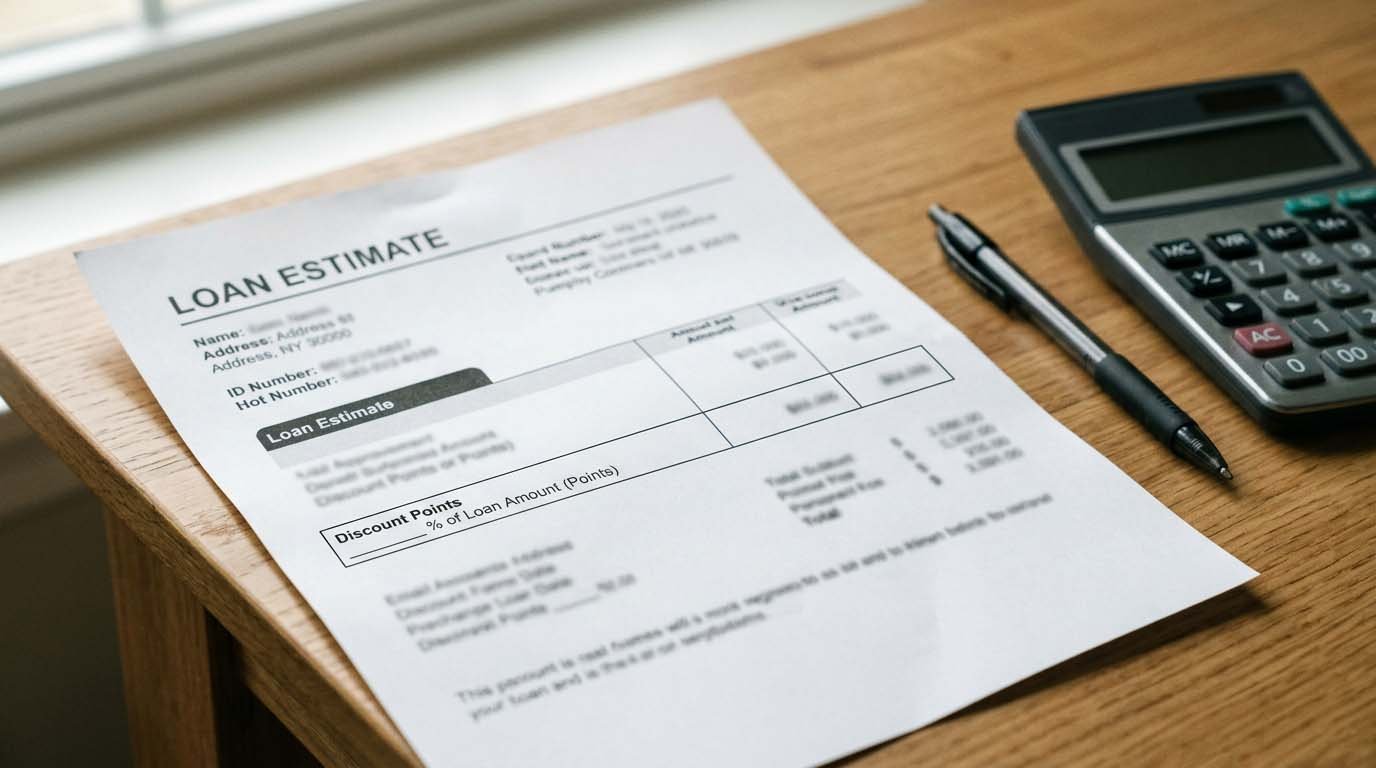
One mortgage point equals 1% of your loan amount. On a $400,000 loan, one point costs $4,000, paid upfront at closing. In exchange, the lender lowers your interest rate, typically by around 0.25% per point. The exact amount varies by lender and market conditions.
You can usually buy a fraction of a point, or several points. How many depends on how much you want to spend upfront and how much rate reduction you’re chasing. Some lenders cap how many points you can buy. Others don’t. Ask directly, since this varies more than people expect.
Discount points versus origination points
Not every point on your loan estimate works the same way. Discount points buy down your interest rate, the type this article focuses on. Origination points are different. They’re a fee the lender charges for processing and underwriting your loan, and they don’t reduce your rate at all.
Both show up as “points” on your closing disclosure, which confuses a lot of buyers. Read the description carefully, or ask your loan officer directly which type you’re being charged. Only discount points involve the rate tradeoff covered here.
The breakeven calculation is the whole decision

Buying points only makes sense if you keep the loan long enough. You need enough time to recoup the upfront cost through lower monthly payments. Divide the upfront cost of the points by your monthly savings, and you get your breakeven point in months.
Say one point costs $4,000 and lowers your monthly payment by $65. Divide $4,000 by $65, and your breakeven lands around 62 months, a bit over five years. Keep the loan past that point, and you come out ahead. Sell or refinance before then, and you’ve lost money on the points compared to just taking the higher rate.
Why your timeline matters more than the math looks like it should
Most homeowners don’t keep a single mortgage for its full 30-year term. People move, refinance, or sell for all kinds of reasons, often well before the loan matures. If there’s a real chance you’ll sell or refinance within five to seven years, points often don’t pay off. That’s true even if the breakeven math looks reasonable on paper.
Be honest with yourself about your actual timeline, not just your current intention to stay forever. Job changes, growing families, and life circumstances shift plans more often than people expect at closing.
Points interact with your loan term too
The same point purchase produces a different breakeven on a 15-year loan than a 30-year loan. Monthly savings and total interest at stake both scale with the loan term. Our 15-Year vs 30-Year Mortgage guide covers how these two decisions interact. Generally, a shorter loan term makes points harder to justify. You have fewer years of monthly savings to recoup the upfront cost.
Run the breakeven math specifically for the loan term you’re actually choosing, not a generic example from a different scenario. The numbers shift more than most buyers expect between a 15-year and 30-year loan at the same rate reduction.
Points can sometimes be tax-deductible, with conditions
The IRS allows some mortgage points to be deducted as prepaid interest, but specific conditions apply. The loan generally needs to be for your primary residence. The points need to be standard practice in your area. Several other requirements come into play too, depending on your situation. This deduction also only helps if you itemize rather than take the standard deduction.
Don’t assume the deduction changes the breakeven math dramatically. For most taxpayers, the standard deduction already exceeds what itemizing would provide. The theoretical tax benefit from points often doesn’t materialize in practice. Confirm your specific situation with a tax professional rather than assuming a deduction you may not actually receive.
Seller-paid points: a different situation entirely
In some markets, sellers offer to pay points on the buyer’s behalf as an incentive to close the sale. This effectively gives you a lower rate without spending your own cash upfront. That changes the math substantially in your favor. There’s no real downside to accepting seller-paid points, since you’re not the one funding the cost.
This is worth negotiating for directly in a buyer’s market. Sellers there have more incentive to offer concessions to close a deal. In a competitive seller’s market, this leverage mostly disappears, and sellers have little reason to offer it.
Points versus a larger down payment: not the same tradeoff
Buyers sometimes conflate points with simply putting more money down, but they work differently. A larger down payment reduces your loan amount directly and can help you cross thresholds that eliminate mortgage insurance. Points don’t touch your loan amount at all. They only affect your interest rate.
If you have extra cash available at closing, compare both options separately rather than assuming they’re interchangeable. Sometimes a larger down payment produces more value, particularly if it helps you avoid mortgage insurance entirely. Other times, points offer a better return, especially if you’re already comfortably above the mortgage insurance threshold.
Points and your loan-to-value ratio can interact

Lenders sometimes price points differently depending on your down payment size, credit score, and loan-to-value ratio. A borrower putting down 20% might get a slightly different rate reduction per point than a borrower putting down 5%, since the underlying risk profile differs. Don’t assume the 0.25% per point figure applies uniformly to every borrower and every loan.
Get a specific, written quote for your exact situation rather than relying on a general rule of thumb. Two borrowers with identical loan amounts can see meaningfully different point pricing based on factors that have nothing to do with the points themselves.
Rate environment changes how attractive points look
When rates are historically low, the relative value of buying down a point tends to shrink, since there’s less room left to compress. When rates are elevated, points can make a bigger dent in your payment, and more borrowers consider them worthwhile. This isn’t a fixed rule, but it’s a pattern worth watching as you compare quotes across different rate environments.
If you’re shopping for a mortgage during a period of unusually high rates, it’s worth asking your lender to run the numbers on points more seriously than you might during a low-rate environment, since the potential savings scale with how far there is to compress.
A worked example

Say you’re financing $350,000 at a base rate of 6.75%. Buying two points costs $7,000 upfront and drops your rate to 6.25%. That reduces your monthly principal and interest payment from around $2,270 to around $2,155, a savings of $115 a month.
Divide $7,000 by $115, and your breakeven lands around 61 months, just over five years. If you’re confident you’ll keep this loan at least six or seven years, the points likely pay off. If you expect to move or refinance within three or four years, skip the points. Keep that $7,000 for other uses instead, since you won’t reach breakeven before the loan ends.
Lender credits work the same way, in reverse
Some lenders offer the opposite trade too: accept a slightly higher interest rate, and they’ll credit you cash toward closing costs instead of charging points. This can help if you’re short on cash at closing, even though it costs more over the life of the loan through a higher rate.
Compare this option against buying points using the same breakeven logic, just flipped. If you’re cash-strapped now and plan to refinance or move soon anyway, a lender credit might make more sense than paying for points you’ll never fully recoup. If you have the cash and plan to stay long-term, points usually win instead.
Shop multiple lenders before deciding
Point pricing isn’t standardized across lenders. One lender might offer a 0.375% rate reduction per point, while another offers only 0.2% for the same point cost. This variation alone can flip your breakeven calculation from favorable to unfavorable, or the reverse.
Get loan estimates from at least three lenders, each showing rates with and without points. Compare the actual numbers side by side rather than assuming one lender’s point pricing represents the market as a whole. A few extra phone calls at this stage can meaningfully change your total cost over the life of the loan.
Run your own numbers
Our Mortgage Calculator lets you compare your monthly payment with and without points. Use your actual loan amount and rate quotes. Ask your lender for a rate quote both with and without points. Then run the breakeven math yourself, rather than accepting the lender’s framing at face value. Still working out your broader budget? Our how much house can you afford guide covers the underlying affordability calculation points feed into.
Common questions about mortgage points
One point costs 1% of your loan amount. On a $300,000 loan, one point costs $3,000. In exchange, your rate typically drops by around 0.25%, though the exact reduction varies by lender and current market conditions.
It depends entirely on how long you’ll keep the loan. Calculate your breakeven point, the upfront cost divided by your monthly savings, and compare it to your realistic timeline. Points make sense if you’ll keep the loan well past that breakeven point. They rarely make sense if you expect to sell or refinance sooner.
Yes, in some situations. Sellers sometimes agree to pay points as a concession to close a sale, particularly in a buyer’s market. This gives you the lower rate without spending your own cash, which is worth negotiating for whenever market conditions favor buyers.
A few more things worth knowing
Discount points buy down your interest rate. Origination points are a separate fee the lender charges for processing your loan, and they don’t affect your rate at all. Both appear as “points” on your closing disclosure, so check the description carefully or ask your loan officer which type applies.
Sometimes, under specific IRS conditions, and only if you itemize deductions rather than take the standard deduction. For many taxpayers, the standard deduction already exceeds what itemizing would provide, so the theoretical benefit doesn’t always materialize. Confirm your specific situation with a tax professional.
They solve different problems. A larger down payment reduces your loan amount and can help you avoid mortgage insurance. Points only lower your interest rate without touching your loan amount. Compare both options separately based on your specific numbers rather than assuming one always beats the other.