Credit Utilization Explained: The 30% Rule Myth
You’ve probably heard you should keep your credit utilization under 30%. That number gets repeated so often it sounds like a law. It isn’t. Here’s what credit utilization actually measures, and why the real target is lower than most people assume.
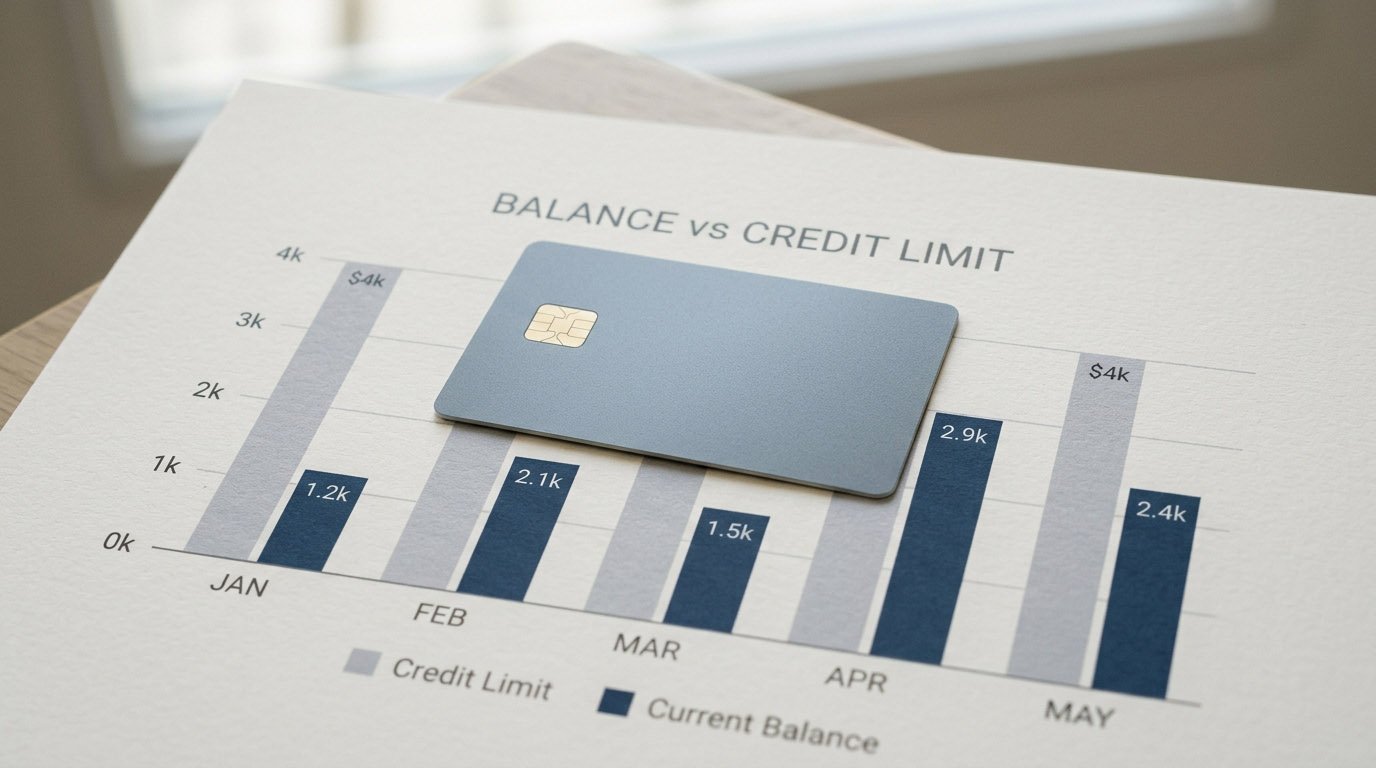
What credit utilization actually means
Credit utilization is the percentage of your available credit that you’re currently using. If your credit card has a $10,000 limit and you’re carrying a $2,000 balance, your credit utilization sits at 20%. Simple enough. The confusion starts when people try to figure out what number they’re supposed to stay under, and where that number even came from in the first place.
You’ll see 30% cited constantly, in blog posts, in bank apps, sometimes even by financial advisors who should probably know better. It’s treated like a hard ceiling, the line between “fine” and “damaging.” That’s not really how it works. FICO and VantageScore, the two companies behind most credit scores, have never published 30% as an official cutoff. It’s more of a folk number, one that got repeated so many times it started sounding like fact.
Where the 30% Number Actually Came From
Nobody can point to a single FICO document that says “keep utilization below 30% or your score suffers.” What credit bureaus and scoring companies have said, repeatedly, is that lower utilization tends to correlate with higher scores, and that people with excellent credit typically use less than 30% of their available credit. Somewhere along the way, that observation about typical behavior got flattened into a rule.
The distinction matters. “People with great scores tend to use under 30%” is a description of a pattern. “Stay under 30% and you’ll be fine” is an instruction, and it’s a weaker one than most people assume. Data from FICO itself shows that consumers with the highest scores, the 800-plus range, usually keep utilization in the single digits, often under 10%. Thirty percent isn’t the target. It’s closer to the point where things start to visibly hurt.
Why Lower Is Almost Always Better

Credit utilization doesn’t work like a light switch that flips at 30%. It behaves more like a slope. Every drop in your utilization tends to nudge your score up a little, and every increase tends to nudge it down, with the effect getting sharper as you approach 100%. Someone at 9% utilization will usually score better than someone at 29%, even though both technically sit “under the 30% rule.”
That’s a fairly big deal, because it means the popular advice isn’t wrong exactly, it’s just set way too high. If you’re optimizing for the best possible score, single digits is where the real benefit shows up, not the mid-20s. Utilization makes up roughly 30% of a FICO score, the second-largest factor after payment history, so it’s not a minor detail either. Getting it right, or wrong, moves the needle more than most people expect.
Per-Card Utilization vs. Overall Utilization
Here’s where people get tripped up in a different way. Utilization gets calculated twice: once across all your cards combined, and once for each individual card. Both numbers matter, and they can tell very different stories.
Say you have two cards. Card A has a $500 limit and a $450 balance. Card B has a $9,500 limit and a $0 balance. Add it up and your overall utilization is a comfortable 4.5%. But Card A, on its own, sits at 90%. Some scoring models weigh that lopsided single-card number heavily, even when your total utilization looks fine on paper. A maxed-out card, even a small one, can quietly drag your score down while your overall percentage looks perfectly healthy.
The fix isn’t complicated. Spread balances more evenly across cards when you can, or pay down the highest-percentage card first, even if it’s not your largest balance in dollar terms. If you’re managing several cards and want to figure out the most efficient order to pay them down, our Credit Card Payoff Calculator can map out a timeline based on your actual balances, limits, and rates.
Does Paying Off a Card in Full Reset Everything?
Not necessarily, and this trips a lot of people up. Credit card issuers report your balance to the bureaus once a month, usually on your statement closing date, not the day your payment is due. If your statement closes while you’re carrying a $2,000 balance, that’s the number that gets reported, even if you pay it off in full a week later before the due date.
So you can pay your card off every single month, never carry a balance, never pay a cent of interest, and still show high utilization if your statement happens to close mid-cycle with a large balance sitting on it. If you’re trying to optimize your score right before applying for a mortgage or a car loan, timing your payment before the statement closing date, not just before the due date, actually matters.
A Quick Example
Picture someone with three cards: a $3,000 limit, a $5,000 limit, and a $2,000 limit. Combined, that’s $10,000 in available credit. Their balances sit at $900, $400, and $700. Total debt: $2,000. Divide $2,000 by $10,000 and overall utilization comes out to 20%, comfortably under the popular 30% line.
But look at the third card. $700 on a $2,000 limit is 35% on its own, worse than the overall number suggests. Pay that one down to $200 and the per-card ratio drops to 10%, while barely moving the total. This is exactly why chasing a single blended percentage can miss what’s actually dragging a score down. If debt is spread across multiple cards and loans and you’re not sure where to focus first, our Debt Payoff Calculator compares snowball and avalanche approaches so you can see which balances to target first for the biggest impact.
Closing a Card Can Backfire

One instinct people have after paying off a card is to close it. That feels responsible, one less temptation, one less thing to manage. But closing a card removes its limit from your total available credit, which mechanically raises your utilization on everything else, even if your actual debt hasn’t changed at all.
Take that earlier three-card example, but imagine the $700 balance had already been paid off, leaving only $200 and $400 on the other two cards. Total available credit was $10,000, so utilization sat at 6%. Now close the $2,000-limit card. Available credit drops to $8,000 while the $600 in remaining balances stays exactly the same. Utilization jumps to 7.5%, a small move here, but with a card carrying a $0 balance and a large limit, closing it can push utilization up sharply, sometimes ten points or more, purely from losing the available credit, not from spending anything new.
None of this means you should never close a card. It just means utilization is one more cost to weigh against annual fees or account clutter, not something to ignore in the decision.
How Credit Utilization Fits Into the Bigger Picture
Utilization is one piece of your credit score, not the whole thing. Payment history carries more weight, and factors like credit age and account mix matter too. If you want the fuller picture of how all these pieces fit together, our article on what makes up a credit score breaks down each factor and how much it typically counts for.
What makes utilization worth focusing on specifically is how fast it moves. Payment history builds over years. Credit age barely budges month to month. Utilization can swing 20 or 30 points in a single billing cycle, just from paying down a balance or opening a new card. That responsiveness cuts both ways, it’s the factor most within your control, and also the one that can quietly work against you if you’re not watching your statement dates.
What to Actually Aim For
Forget the 30% number as a target. Treat it as the point past which things start getting worse in a noticeable way. If you’re actively trying to raise your score, single digits on both your overall and per-card utilization is the real goal, ideally under 10%, and 0% isn’t a problem either, contrary to another myth that says you need to carry a small balance to “show activity.” You don’t. A paid-off card still reports as an active account.
Check your utilization the way it actually gets reported, on your statement closing date, not just when your bill is due. And if you’re managing balances across several cards, pay attention to each one individually, not just the combined total. A single overloaded card can undercut an otherwise healthy credit profile.
Common questions about credit utilization
No. This is a common myth. A card reporting a $0 balance still counts as an active, well-managed account. You don’t need to carry a balance or pay interest to show activity. Paying your card off in full every month is fine for your score.
Card issuers typically report your balance to the credit bureaus once a month, usually on your statement closing date. That means your utilization can look different from what you expect if you check it right after a big purchase but before your statement closes.
Not exactly. FICO and VantageScore weigh utilization somewhat differently, and newer scoring models sometimes look at trends over time rather than a single snapshot. The general principle holds across most models, though: lower utilization tends to help, and per-card balances matter alongside the overall total.
A few more things worth knowing
If you’re trying to optimize your reported utilization, pay down your balance before your statement closing date, not just before the due date. The balance on your statement closing date is usually what gets reported to the bureaus, regardless of when you actually pay it.
Yes, mathematically. A higher limit with the same balance lowers your utilization percentage. Keep in mind some issuers run a hard inquiry when you request a limit increase, which can cause a small, temporary dip in your score before the utilization benefit shows up.
Both matter, but a single maxed-out card can hurt your score even if your combined utilization across all cards looks low. Scoring models generally look at both numbers, so it’s worth checking each card individually rather than just your blended total.