Index Funds vs Mutual Funds: What’s the Difference
Index funds vs mutual funds is a comparison a lot of people get wrong from the start. An index fund is actually a type of mutual fund. The real question isn’t which category wins. It’s active versus passive, and that choice affects your returns more than most people realize.

The Category Confusion, Cleared Up
Here’s the part that trips people up. An index fund isn’t a separate thing from a mutual fund. It’s one specific kind of mutual fund. A mutual fund is just a pooled investment. Money from many investors, combined and managed as one fund. That’s the whole definition. Index funds fit inside that definition.
So when people ask about index funds vs mutual funds, they’re usually not comparing two different categories. They’re comparing two different fund management styles. One style tracks a market index passively. The other has a manager actively picking investments, trying to beat the market. That’s the real distinction hiding behind the phrase.
What an Index Fund Actually Does
An index fund tracks a specific market index, like the S&P 500. It holds the same stocks that index holds, in roughly the same proportions. No manager picks winners. No manager tries to time the market. The fund simply mirrors whatever the index does, up or down.
This passive approach keeps costs low. There’s no research team, no analysts, no active trading desk to pay for. Index funds typically charge an expense ratio well under 0.20%, and some of the largest ones charge under 0.05%. On a $50,000 portfolio, that’s the difference between paying $25 a year and paying $250 or more.
What an Actively Managed Mutual Fund Actually Does

An actively managed mutual fund pays a manager, or a team of managers, to pick individual investments. Their goal is to beat the market, not just match it. Researching companies is a full-time job for that team. Economic conditions get factored in as holdings shift throughout the year. The whole point is spotting opportunities before everyone else does.
That effort costs money. Actively managed funds typically charge expense ratios between 0.5% and 1.5%, sometimes higher. You’re paying for expertise and the chance at outperformance. The catch is that outperformance doesn’t happen as often as the fee structure implies.
Does Active Management Actually Beat the Market?
Rarely, and not consistently. Data from S&P’s SPIVA scorecard tracks active fund performance against benchmarks year after year. It shows that most actively managed U.S. stock funds underperform their benchmark index over long time horizons, often 10 to 15 years or more. The gap gets wider the longer you measure it.
This doesn’t mean every active manager fails. Some beat the market for years at a stretch. The problem is picking which manager will do that in advance, before the fact, not after. Most investors who pick based on past performance end up chasing funds that already had their best years behind them.
Why Fees Matter More Than People Assume
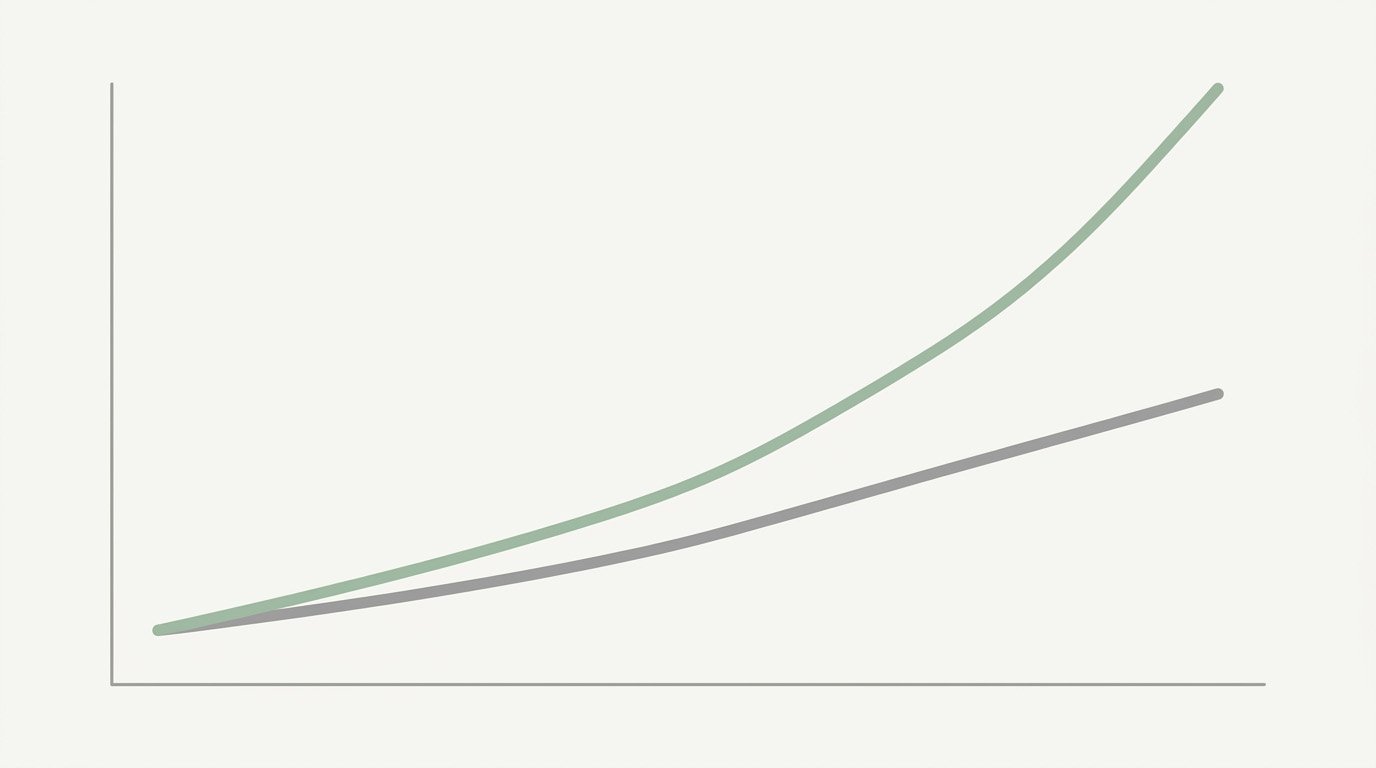
A 1% difference in fees sounds small. Over decades, it compounds into a real gap. Take two $10,000 investments earning 7% annually before fees. One sits in an index fund charging 0.05%. The other sits in an active fund charging 1%. After 30 years, the index fund grows to roughly $74,000. The active fund, dragged down by that extra 0.95% in annual fees, grows to closer to $57,000.
That’s a $17,000 gap, and it comes entirely from fees, not from any difference in the underlying market return. The fee gets deducted whether the fund does well or poorly that year, so it acts like a constant drag on your balance. If you want to see how a smaller fee difference plays out on your own numbers, our Investment Calculator lets you compare growth at different rates over any time period you choose.
It’s also worth noting that fees compound in the opposite direction of your returns. A good year with a high fee still costs you the same dollar amount in fees as a flat year would, proportionally speaking. That’s part of why a seemingly small percentage adds up to so much over a long enough timeline.
Where Active Management Sometimes Makes Sense
Index funds work best in large, efficient markets, like U.S. large-cap stocks, where so much information is public that it’s hard for any manager to find a consistent edge. In smaller, less-covered markets, some argue active management has more room to add value. Emerging markets, small-cap stocks, and certain bond categories get cited most often.
Even in those areas, the evidence for consistent outperformance is mixed at best. It’s a reasonable argument, not a guarantee. If you’re building a portfolio and want a simple starting point, most index funds covering the total U.S. stock market, or a broad global index, capture the bulk of long-term market growth without needing to guess which active manager will outperform.
Minimum Investments and How You Buy Each One
Traditional mutual funds, index or active, often carry a minimum initial investment, commonly $1,000 to $3,000, though some brokerages have dropped this requirement entirely. You buy and sell mutual fund shares once a day, after the market closes, at a price called the net asset value.
Many investors today access index funds through ETFs instead, exchange-traded funds that track the same indexes but trade throughout the day like a stock. ETFs often have no minimum beyond the price of a single share, and many brokerages now offer fractional shares, letting you invest with as little as $5 or $10.
How This Fits Into Retirement Accounts

Most 401(k) plans offer a mix of both index and actively managed mutual fund options. Check your plan’s fund lineup and compare the expense ratios listed in the fund fact sheet. A target-date fund, common in many 401(k)s, often blends index funds internally, but charges a slightly higher fee for the automatic rebalancing it does as you approach retirement.
If you’re deciding between a Roth and traditional account structure for your retirement savings, that’s a separate decision from index versus active funds, and it depends more on your current versus expected future tax rate. Our article on Roth vs. traditional IRA breaks down that choice in detail.
A Simple Way to Decide
If you want the lowest realistic cost and a return that closely tracks the broad market, an index fund does that job reliably. If you believe a specific manager has genuine skill, or you want exposure to a niche strategy an index can’t capture, an actively managed fund might fit that specific goal. Most long-term investors do best building a core portfolio around low-cost index funds, and treating active funds as a smaller, deliberate addition rather than the default choice.
If you’re investing on a regular schedule regardless of which fund type you choose, our article on dollar-cost averaging explains why investing steadily over time tends to smooth out the ups and downs of whichever fund you pick.
Common questions about index funds vs mutual funds
Yes. An index fund is a mutual fund that passively tracks a market index instead of being actively managed. The phrase “index funds vs mutual funds” really compares passive versus active management, not two separate fund categories.
Almost always, yes. Index funds typically charge expense ratios under 0.20%, sometimes under 0.05%, while actively managed funds usually charge 0.5% to 1.5% or more. That gap comes from the cost of research and active trading.
Some do, in some years. But data tracking long-term performance shows most actively managed U.S. stock funds underperform their benchmark index over 10 to 15 year periods, largely due to higher fees eating into returns.
A few more things worth knowing
Both track the same kind of index. A traditional index mutual fund trades once a day at the closing price, while an index ETF trades throughout the day like a stock. ETFs also tend to have lower minimum investment requirements.
Yes. An index fund tracks its underlying index in both directions. If the market index falls, the fund falls with it. Index funds reduce manager-specific risk, but they don’t eliminate general market risk.
Many long-term investors build most or all of their portfolio around low-cost index funds, given the fee and performance data. Some choose to add a smaller allocation to actively managed funds for specific strategies or niche markets, but that’s a personal choice, not a requirement.