Emergency Fund vs Investing: Where Should Your Money Go First?
Every extra dollar can only go one place at a time, and the emergency fund versus investing question is one of the most common places people get stuck. The honest answer isn’t either-or. It’s an order of operations, and the order matters more than most people realize.

Why this isn’t really an either-or question
Framing this as a single choice, emergency fund or investing, makes it sound more dramatic than it needs to be. In practice, most financial guidance treats it as a sequence. A starter emergency fund comes first. Any free employer retirement match gets captured next. The emergency fund gets finished after that. Investing beyond the match ramps up once that foundation is in place.
FINRA’s guidance for new investors puts it plainly: before investing, get your basic financial needs in order, including money set aside to cover an emergency. That’s not because investing is a bad idea early on. It’s because investing without a cash cushion tends to backfire at exactly the worst moment.
The risk investing skips past
Here’s the scenario emergency-fund-first advice is built to prevent. Every spare dollar goes into the market. Six months later, a job loss hits, right as the market happens to be down 20%. Without cash reserves, the only source of money is the investment account itself. That forces a sale at a loss, at the worst possible time, just to cover rent and groceries.
This isn’t a rare edge case. Job losses and market downturns often cluster together, since both tend to happen during the same broader economic slowdown. An emergency fund exists specifically to break that link. It lets a downturn in the market and a downturn in income happen at the same time without forcing your hand.
The one exception: the employer match

Even the emergency-fund-first camp usually carves out one exception. If an employer matches retirement contributions, capture at least enough to get the full match before finishing the emergency fund. A typical match, say 50% or 100% on the first few percent of pay, is an immediate, guaranteed return that no market investment can reliably promise. Walking away from it to build cash savings a little faster almost never makes mathematical sense.
Beyond the match, though, the case for pausing extra investing until the emergency fund is solid gets much stronger. That’s where the real tradeoff lives.
Running the actual numbers
Say you have $500 a month to allocate, and $4,000 already saved toward a $6,000 emergency fund goal. Option one: split the $500 evenly, $250 to savings and $250 to a taxable brokerage account. Option two: send the full $500 to savings until the fund is complete, then redirect all of it to investing.
Under option one, it takes eight months to finish the emergency fund. Under option two, it takes four. The difference in investment growth over those four months is small, a few hundred dollars at most in a typical market. The difference in how exposed you are to an unplanned expense during those four months is not small. A sudden $2,000 repair bill in month two looks very different depending on which path you chose.
This is really a question about the cost of delay versus the cost of exposure. Delaying investing by a few months costs some amount of expected return, but that cost is modest and diversifiable across a career. Being exposed to an emergency with no cushion costs far more when it actually happens. There’s no way to diversify away a single bad month with no savings behind it.
A quick example: two versions of the same emergency
Picture the same $2,000 car repair happening to two people. Person A finished a $6,000 emergency fund a few months back. Person B skipped that step and put every spare dollar into a brokerage account instead.
Person A pays the $2,000 from savings. The fund drops to $4,000. Within a few months of normal saving, it’s back to full. No debt, no sold investments, no disruption to the rest of the plan.
Person B has no cash cushion. Two options remain: sell $2,000 worth of investments, possibly at a loss if the market happens to be down that month, or put the repair on a credit card at 20% or more interest. Either path costs real money beyond the $2,000 repair itself. Person A’s plan absorbed the shock. Person B’s plan passed the cost along.
What changes the calculation
A few real factors shift this from a default answer toward a genuinely personal one. Job stability matters. Someone in a highly stable field with strong severance protections carries less risk from a thin emergency fund than someone in a volatile industry or gig work. A second household income changes the picture too, since a job loss for one earner doesn’t necessarily mean zero income for the household.
Access to other safety nets matters as well. Someone with family who could genuinely help in a true crisis, or significant home equity available through a line of credit, has more flexibility than someone without either option. None of these factors eliminate the case for an emergency fund. They can reasonably shrink how large that starter fund needs to be before extra investing ramps up.
High-interest debt changes the order too
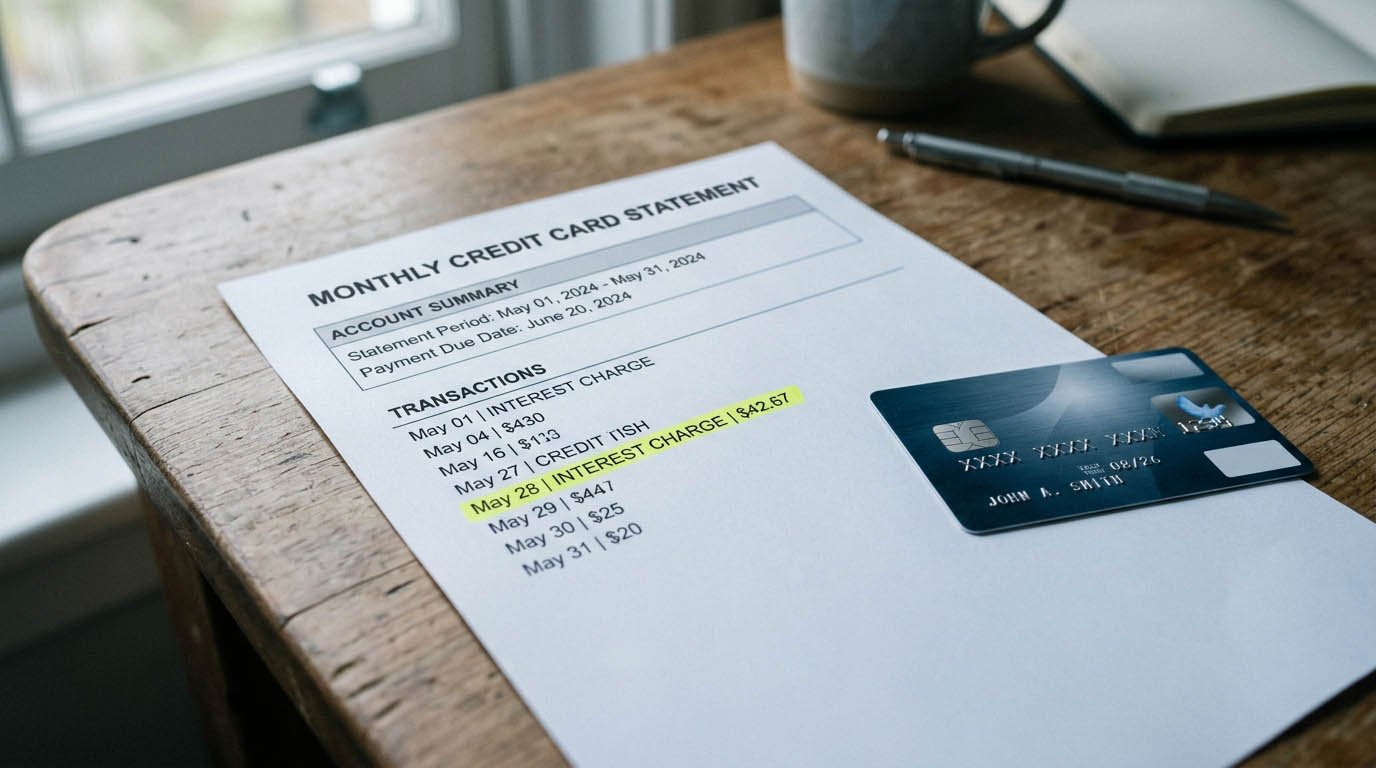
Carrying high-interest debt, credit card balances especially, usually jumps ahead of extra investing in the priority order. It often jumps ahead of finishing a full six-month emergency fund too. A card charging 22% interest is a guaranteed 22% cost every year that balance sits there. Almost no investment reliably beats that, so paying it down functions like a very high, risk-free return.
The common approach: build a small starter emergency fund first, a thousand dollars or so. Capture the employer match next. Then aggressively attack high-interest debt before circling back to finish the full emergency fund and ramp up investing. Our Debt Payoff Calculator and Credit Card Payoff Calculator can show how much that interest actually costs you if it lingers.
The psychological factor is real too
There’s a behavioral piece to this that pure math tends to miss. Investors with no cash cushion often panic during market downturns. That happens partly because a falling portfolio also feels like a falling safety net. That fear leads to selling at the bottom. It locks in losses that a calmer investor, with cash reserves in place, could have simply ridden out.
An emergency fund isn’t just a source of cash for true emergencies. It’s also a psychological buffer. It makes it easier to leave investments alone during a downturn, since the rent and grocery money isn’t riding on the market’s next move. That steadiness tends to matter more for long-term returns than most people expect. Staying invested through downturns is one of the more reliable drivers of long-run investment performance.
Why a few months of delay barely moves the needle
Zoom out to a full career, and the sequencing question shrinks considerably. Delaying extra investing by three to six months, while a starter emergency fund gets built, barely changes a decades-long compounding timeline. The difference between starting to invest in March versus starting in September of the same year barely registers thirty years later. A few months, spread across forty working years, is simply too small a slice to move a lifetime compounding curve in any meaningful way.
What does register, over a full career, is whether an unexpected expense ever forces a bad decision. Selling investments at a loss during a downturn, or taking on high-interest debt to cover a gap, can undo months of otherwise steady progress. Sometimes it undoes years, all in a single bad stretch. The order of operations exists to prevent that single bad stretch, not to squeeze out a marginally higher return in the meantime.
A practical sequence to follow

Putting it together, a reasonable default order looks like this. First, a starter emergency fund of $1,000 to $2,000, enough to absorb a minor shock without new debt. Second, the full employer retirement match, if one is offered. Third, high-interest debt paydown. Fourth, finishing the emergency fund to a full three to six months of expenses. Fifth, investing beyond the match ramps up in earnest.
Treat this as a default, not a rigid rulebook. Someone with rock-solid job security and no high-interest debt might reasonably compress steps three and four. They might even run those steps alongside step five instead of strictly in sequence. The sequence exists to protect against the worst-case version of getting this wrong, not to slow down someone whose situation genuinely carries less risk.
Check your own numbers
Our Emergency Fund Calculator shows how large your fund should be, based on your actual monthly expenses. Our Investment Calculator models what a given monthly investment grows into over time. Together, they show exactly what a few months of delayed investing does, and doesn’t, cost you in the long run.
Common questions about emergency funds vs investing
Not entirely. Keep contributing enough to capture any employer match, since that’s close to free money. Beyond the match, prioritizing the emergency fund for a few months is a reasonable tradeoff, not a permanent pause on investing.
Without a match to capture first, the case for finishing the emergency fund before ramping up other investing gets even stronger. There’s no guaranteed, immediate return being left on the table by waiting.
It’s riskier, and most guidance advises against it, but circumstances vary. Someone with substantial existing savings elsewhere, or very low fixed expenses and strong job security, carries less downside than someone with neither. For most people starting from zero, a small cash cushion first is the safer sequence.
A few more things worth knowing
The underlying order usually stays the same, but the target emergency fund size often grows. More dependents typically means less flexibility to cut expenses quickly during a job loss, a reasonable argument for building toward the higher end of the three to six month range.
No. That defeats the entire purpose of keeping the fund separate. A market dip is exactly the kind of environment where job losses become more common, which is when you’re most likely to need that cash fund intact.
Irregular income is one of the strongest arguments for prioritizing a larger emergency fund before ramping up investing. Income gaps are a normal, expected part of that kind of work, rather than a rare emergency. Many people with variable income aim for six to twelve months of expenses instead of the standard three to six.