Short-Term vs. Long-Term Capital Gains
One date on your brokerage statement can double your tax bill. The difference between short-term vs long-term capital gains comes down to a single number: how many days you held the asset before you sold it. Get that number wrong, and you could hand the IRS thousands of dollars you didn’t need to.

The one date that decides everything
When you sell an investment for a profit, the IRS asks one question first: how long did you own it? Hold an asset for one year or less, and the profit counts as a short-term capital gain. Hold it for more than one year, and the profit counts as a long-term capital gain instead. That one detail decides which set of tax rules applies to your entire sale.
That single distinction, short-term vs long-term capital gains, decides which tax rules apply to your entire profit. It’s not a minor technicality. It’s the difference between two completely separate tax systems. The gap between them can be enormous on a large gain. Our What Is Capital Gains Tax? guide covers the basics if you need the foundation first.
How short-term gains get taxed
Short-term gains don’t get their own special rate. The IRS simply adds the profit to your other income for the year and taxes the whole pile at your ordinary income rate. For 2026, those ordinary rates run from 10% up to 37%, depending on your taxable income and filing status.
This is exactly the same rate structure that applies to your paycheck. Sell a stock you’ve held for six months and pocket a $20,000 profit, and that $20,000 gets stacked on top of your salary. If that pushes you into the 32% bracket, a meaningful chunk of the gain gets taxed at 32%. That’s not some lower “investment” rate, it’s simply your ordinary rate. Our What Is a Tax Bracket? guide explains how that stacking actually works, bracket by bracket.
How long-term gains get taxed
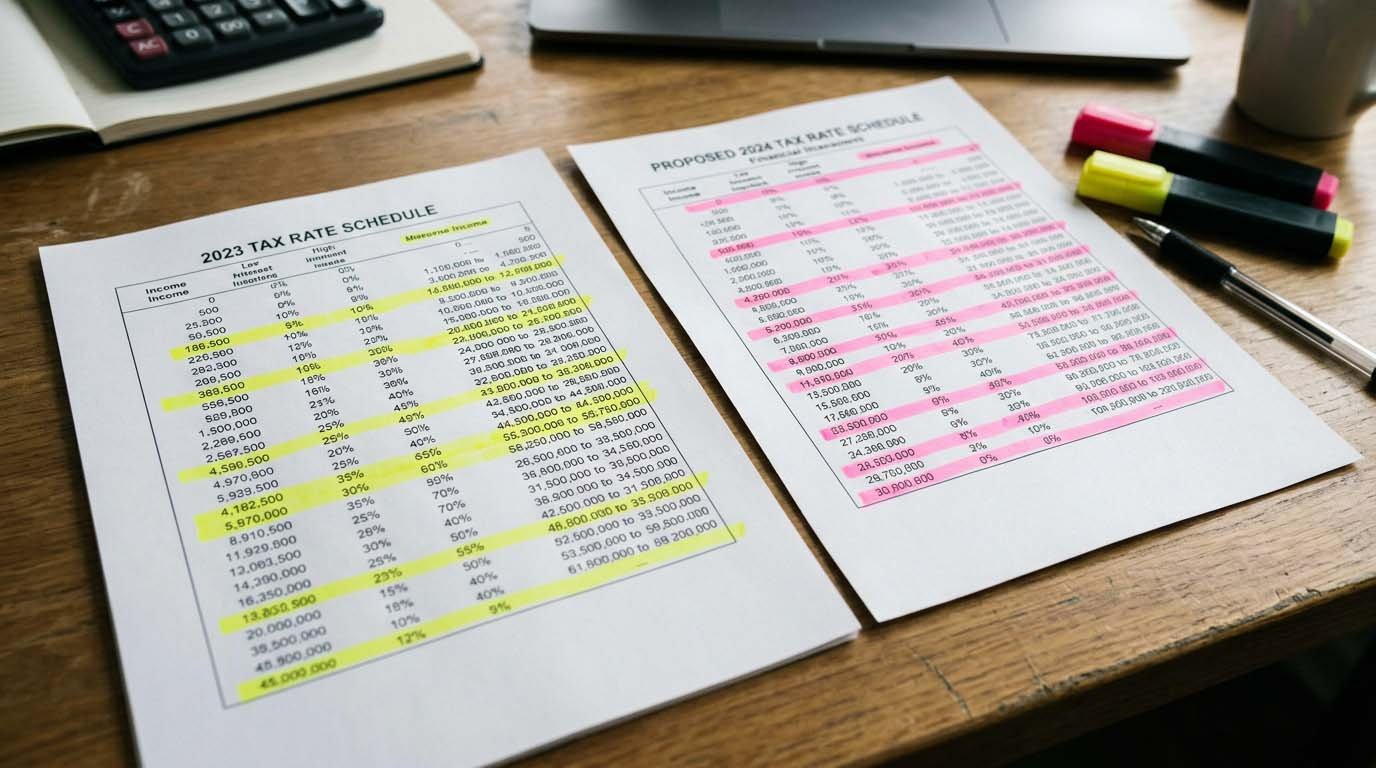
Cross the one-year mark, and everything changes. Long-term gains get taxed at just three possible rates: 0%, 15%, or 20%. For 2026, single filers pay 0% on gains up to $49,450 of taxable income. Married couples filing jointly get that 0% rate up to $98,900. The 15% rate covers the large middle band, up to $545,500 for single filers or $613,700 for married couples. Above those thresholds, the top rate of 20% applies.
Compare that to the 37% top rate on short-term gains, and the incentive to wait becomes obvious. High earners with large investment income may also owe an extra 3.8% Net Investment Income Tax once their modified adjusted gross income passes $200,000 single or $250,000 joint. Even with that surtax added in, long-term treatment almost always beats short-term.
The same $50,000 gain, two very different tax bills
Numbers make this easier to see than percentages alone. Say a single filer earns $100,000 in salary and realizes a $50,000 gain on a stock sale. If that stock was held for eight months, the gain is short-term. It stacks on top of the $100,000 salary and gets taxed at ordinary rates. Most of it lands in the 24% bracket. The federal tax on that gain alone comes to roughly $12,000.
Now imagine the same investor waited four extra months, crossing the one-year mark before selling. The exact same $50,000 gain is now long-term. Stacked on top of $100,000 of ordinary income, most of it falls into the 15% long-term bracket. The federal tax drops to around $7,500. Same stock, same profit, same investor. The only thing that changed was the calendar, and it saved roughly $4,500.
Why the tax code rewards patience
This gap isn’t an accident or a loophole. Congress built it deliberately. Lawmakers designed the lower long-term rates to encourage people to hold investments rather than trade them constantly. The theory: patient capital supports businesses and the broader economy better than short-term speculation does.
Whether or not that policy goal actually works as intended is debated among economists. But the practical result for individual investors is straightforward: the tax code has a built-in reward for waiting, and it’s one of the few tax advantages that requires no special account, no paperwork, and no minimum income. It’s available to anyone who’s willing to hold an appreciated investment for a little longer before cashing out.
Practical timing decisions worth thinking through
The most obvious move is also the simplest: check your purchase date before you sell. If you’re a few days or weeks away from the one-year mark on a large gain, waiting can be worth thousands of dollars. Many brokerages show your cost basis and purchase date right on the trade screen, so this takes only a moment to verify before placing an order.
Year-end timing matters too. Realizing a large short-term gain in December instead of January can push you into a higher bracket for that tax year, especially if your income already fluctuates. Spreading a sale across two calendar years, when possible, sometimes keeps more of the gain in a lower bracket. None of these moves require exotic strategies. They just require checking the calendar before you click sell, rather than after the trade confirmation email arrives.
Where the accounts you use come in
The short-term vs long-term capital gains distinction only applies to taxable brokerage accounts. Inside a Roth IRA, the holding period stops mattering entirely. Qualified withdrawals come out tax-free regardless of how long you held any individual investment inside the account. Inside a traditional IRA or 401(k), gains grow tax-deferred and get taxed as ordinary income on withdrawal, again without any short-term or long-term distinction along the way. Our Roth vs. Traditional IRA guide walks through how those two account types compare.
This is one reason financial advisors often suggest holding frequently traded investments inside tax-advantaged accounts. Save your taxable brokerage account for positions you’re likely to hold longer term instead. It sidesteps the short-term rate problem entirely for the assets you trade most actively, without requiring any change to your actual investment strategy.
Dividends follow a similar split
The short-term vs long-term capital gains distinction has a close cousin in dividend taxation. Dividends get split into “qualified” and “ordinary” categories, and the difference works a lot like the capital gains split does. Qualified dividends get taxed at the same favorable 0%, 15%, or 20% rates as long-term capital gains. Ordinary, or “non-qualified,” dividends get taxed at your regular income rate instead.
To count as qualified, you generally need to hold the underlying stock for more than 60 days within a specific window around the dividend payment date. Miss that window, and a dividend that looks identical on your statement gets taxed at a meaningfully higher rate. It’s an easy detail to overlook if you trade around a company’s dividend date without checking the rule first. Our Dividend Investing 101 guide covers how that holding-period rule works in more detail, including how it interacts with dividend reinvestment plans.
Mutual funds can create short-term gains you never chose
Here’s a wrinkle that catches a lot of people off guard. You can owe short-term capital gains tax on a mutual fund even if you personally held your shares for years. That’s because the fund itself buys and sells securities inside its portfolio all year long. Any gains from trades the fund made within its own one-year window get passed through to you as short-term, regardless of your own holding period. This can happen in a year when the fund’s share price actually dropped, which understandably frustrates a lot of investors the first time they see it on a statement.
This is one reason actively managed funds sometimes generate surprisingly large tax bills even in years when the fund’s overall price barely moved. Index funds, which trade far less often, tend to generate fewer of these short-term surprises. It’s worth checking a fund’s turnover rate before investing a large sum in a taxable account, rather than only checking its returns.
Run the numbers before you decide

Deciding between short-term vs long-term capital gains treatment usually comes down to one question: is the tax savings from waiting worth more than the risk of the price moving against you before the year is up? That’s a personal call. It depends on how confident you are in the investment, and how close you already are to the one-year mark.
Our Investment Calculator can help you estimate what a position might be worth if you leave it invested a little longer. If you’re weighing this sale against a different opportunity entirely, our ROI Calculator lets you compare the after-tax return on each path side by side.
This article is educational, not tax advice, and a qualified tax professional can help you apply these rules to your specific numbers. But checking your holding period before you sell costs nothing, and it’s often the single highest-value move available to an investor sitting on a gain.
Common questions about short-term vs long-term capital gains
You need to hold an asset for more than one year, not exactly one year. Selling on the one-year anniversary of your purchase still counts as short-term. You need to wait until day 366, or later, to qualify for long-term treatment.
Congress designed the lower rates to encourage long-term investing over frequent trading. The idea is that capital committed for longer periods supports businesses and economic growth more than short-term speculation does.
No. Inside a Roth IRA, qualified withdrawals are tax-free regardless of how long you held any specific investment. The short-term versus long-term distinction only applies to gains in taxable brokerage accounts.
A few more things worth knowing
Yes. Short-term gains and losses are netted against each other first, and long-term gains and losses are netted against each other separately. Any remaining net short-term gain or loss is then combined with the net long-term result to determine your overall tax outcome.
Generally, yes. Inherited assets typically receive long-term capital gains treatment regardless of how long you personally held them after inheriting, thanks to a special rule in the tax code. This is separate from the “stepped-up basis” rule that also applies to inherited assets.
Each batch of shares, often called a “tax lot,” keeps its own purchase date and cost basis. Some lots you sell might qualify as long-term while others from the same position are still short-term, depending on when each batch was actually purchased.