How to Build a Diversified Investment Portfolio
Nobody can reliably predict which stock, sector, or country will outperform next year. Diversification doesn’t try to guess. It spreads your money across enough different holdings that no single bad outcome can sink the whole portfolio. Here’s how to actually build one, piece by piece.

Not needing to be right about any one thing
Diversification means owning a wide enough mix of investments. No single company, sector, or country should be able to wreck your overall results. Our What Is Diversification? article covers the core concept in depth. This guide focuses on the practical side. It walks through how to actually build a diversified portfolio, step by step, rather than just understanding why it matters.
The goal isn’t to eliminate risk entirely. Markets carry risk by nature, and diversification doesn’t change that. What it does is reduce a different risk: the risk of a single bad bet. That’s the kind where one company collapses, or one sector crashes, and takes your entire portfolio down with it. A diversified portfolio absorbs that kind of shock far better than a concentrated one.
Start with your asset allocation
Asset allocation is the split between broad categories: stocks, bonds, and cash, along with any other asset classes you choose to include. This split matters more than almost any other decision you’ll make as an investor. Research on portfolio returns consistently points to asset allocation as the single biggest driver of long-term results. It matters more than which specific stocks or funds you pick within each category.
A younger investor with decades until retirement can typically afford a heavier allocation to stocks. There’s time to recover from downturns. Someone closer to retirement usually shifts toward a larger bond allocation instead, prioritizing stability over growth. There’s no single right split. The right mix depends on your timeline, your goals, and how much volatility you can stomach without making panicked decisions.
Diversify within each asset class too

Picking a mix of stocks and bonds is only the first layer. Within your stock allocation, spread across different sectors, company sizes, and industries. A portfolio holding only technology stocks isn’t diversified, even if it holds twenty different companies. A downturn in that one sector hits everything at once. The same logic applies to bonds. Government bonds, corporate bonds, and bonds of different maturities all behave somewhat differently under different economic conditions.
This is where index funds do most of the heavy lifting for ordinary investors. A single broad market index fund can hold hundreds or thousands of companies across every major sector. That instantly diversifies your stock allocation without requiring you to pick winners yourself.
How many holdings is actually enough
Research on diversification generally finds that most of the risk-reduction benefit shows up within the first 20 to 30 individual stocks. That assumes they’re spread across different sectors rather than concentrated in one. Beyond that point, adding more individual holdings delivers diminishing returns for the added complexity.
This is exactly why a single broad index fund often beats trying to hand-pick dozens of stocks yourself. It gives you far more than 30 holdings in one purchase. Everything gets spread automatically across sectors, without the ongoing effort of researching and monitoring each company individually.
Low-cost index funds do most of the work
For most individual investors, a handful of broad, low-cost index funds achieves better diversification than a hand-picked collection of individual stocks. A total stock market index fund alone spreads your money across thousands of companies. Pair it with a total bond market fund, and you’ve covered two major asset classes in just two purchases. Our What Is an Expense Ratio? article explains why keeping the fees on these funds low matters just as much as the diversification itself. Fees compound against you the same way returns compound for you.
Our Index Funds vs Mutual Funds and ETF vs Stock articles cover the practical differences between fund types. That’s worth a read if you’re deciding which vehicle fits your account and goals best.
Don’t forget geographic diversification

Many investors build a portfolio entirely out of domestic companies. This is usually because those are the names they recognize. It leaves out a substantial share of the global economy. International index funds add exposure to companies and economies that don’t move in perfect lockstep with your home market. That can smooth out returns when your domestic market hits a rough patch.
There’s no universal rule for how much international exposure to hold. Some investors prefer a modest allocation. This reflects the fact that many large domestic companies already generate substantial revenue overseas. Others prefer a larger international allocation, closer to the actual size of international markets relative to the global economy. Either approach is reasonable, as long as it’s a deliberate choice rather than an oversight.
Rebalancing keeps the mix from drifting
Over time, different assets grow at different rates, which quietly shifts your original allocation. A portfolio that started at 70% stocks and 30% bonds can drift to 80% stocks after a strong few years for the market. Stocks simply grew faster than bonds. Rebalancing means periodically selling a portion of what’s grown and buying more of what’s lagged, restoring your original target mix.
This isn’t just bookkeeping. Rebalancing forces a disciplined version of buying low and selling high. It systematically trims positions that have run up and adds to positions that haven’t. Most investors rebalance once or twice a year, or whenever an allocation drifts a set percentage away from its target.
Where you hold your diversification matters too
Rebalancing inside a tax-advantaged account, like a 401(k) or IRA, usually triggers no tax consequences. You’re simply moving money between funds within the same shielded account. Rebalancing inside a regular taxable brokerage account is different. Selling an appreciated position to rebalance can trigger capital gains taxes, which eats into the benefit of rebalancing in the first place.
One workaround for taxable accounts: rather than selling winners to fund purchases of laggards, direct new contributions toward whichever asset class has fallen behind its target. This achieves a similar rebalancing effect over time without forcing a taxable sale. It works best when you’re regularly adding new money to the portfolio, which is the case for most people still in their working years.
Automation removes the guesswork
Many brokerages and robo-advisors now offer automatic rebalancing, where the platform monitors your allocation and adjusts it back to target without you needing to remember or execute the trades yourself. This removes one of the biggest practical obstacles to sticking with a diversified strategy: the tendency to simply forget, or to hesitate during a volatile market when rebalancing feels emotionally difficult.
Setting up automatic contributions alongside automatic rebalancing turns diversification into something that happens in the background, rather than a task that requires ongoing willpower and attention. For most long-term investors, that kind of automation is worth more than any small edge gained from manually timing individual trades.
A simple example portfolio
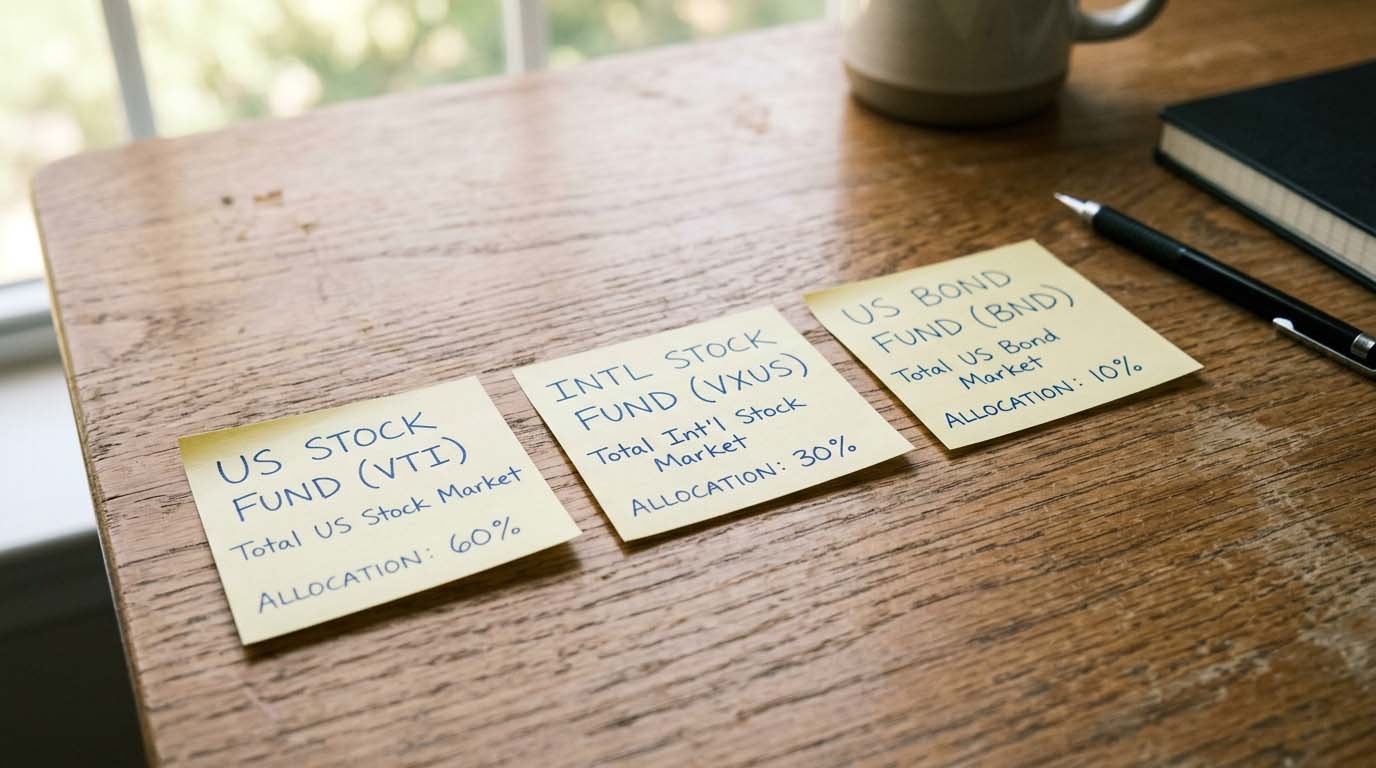
A common starting point for a long-term investor might look like this: 60% in a total domestic stock market index fund, 20% in a total international stock market index fund, and 20% in a total bond market index fund. Three funds, purchased through a handful of trades. That mix diversifies across thousands of underlying holdings, multiple sectors, and multiple countries.
This isn’t the only reasonable allocation, and it isn’t personalized advice for any specific situation. It illustrates how few individual purchases it actually takes to build broad diversification. Low-cost funds do the work that would otherwise take dozens of individual stock picks.
Common mistakes that undermine diversification
Owning several funds that all track the same or overlapping indexes can create an illusion of diversification without the substance. Check for overlap before assuming more funds automatically means more diversification. Holding too much company stock through an employer stock plan is another common pitfall. It ties both your paycheck and your portfolio to the same company’s fortunes. A market downturn during a bear market can also tempt investors into abandoning their allocation at the worst possible time. Our Bear Market vs Bull Market article covers what the historical data actually shows about staying the course through downturns.
Chasing last year’s best-performing fund is another trap worth avoiding. Past performance says little about future results, and jumping between funds based on recent returns tends to lock in the worst of both worlds: buying high after a run-up, then selling low once that fund inevitably cools off.
Build it around your own timeline
The right diversified portfolio depends on your specific goals, timeline, and comfort with risk. There’s no single allocation that fits everyone. Our Investment Calculator can help you model how different allocations and contribution amounts might grow over your own investment horizon. You can see the trade-offs in real numbers rather than the abstract.
Building a diversified portfolio isn’t a one-time task either. As your timeline shifts, your goals change, or your comfort with risk evolves, it’s worth revisiting the mix rather than assuming the allocation you picked years ago still fits your life today.
Common questions about building a diversified portfolio
Research suggests most of the diversification benefit shows up within 20 to 30 individual holdings, spread across sectors. A single broad index fund typically holds far more than that, which is why many investors rely on funds rather than picking dozens of stocks themselves.
For most investors, index funds achieve broader diversification with far less effort. A single fund can hold hundreds or thousands of companies, instantly diversifying across sectors in a way that’s difficult to replicate by hand-picking individual stocks.
Most investors rebalance once or twice a year, or whenever an allocation drifts a set percentage away from its target, such as five percentage points. There’s no universal schedule, but rebalancing too rarely lets your risk profile drift, while rebalancing too often can generate unnecessary trading costs.
A few more things worth knowing
Many financial professionals recommend at least some international exposure, since it diversifies beyond your home market’s economic cycles. How much to hold is a matter of preference, and reasonable investors land on different percentages depending on their views.
Yes, in a practical sense. Owning dozens of overlapping funds that track similar indexes adds complexity and can make tracking your actual allocation harder, without meaningfully improving diversification beyond what a few broad funds already provide.
No. Diversification reduces the risk tied to any single company or sector, but it doesn’t eliminate market risk entirely. A diversified portfolio can still decline in value during a broad market downturn, just typically less severely than a concentrated one.