What Is Asset Allocation?
Before you pick a single stock or fund, one decision shapes your results more than any other. How much goes into stocks, how much into bonds, and how much sits in cash. That split is asset allocation. Here’s how it works, and how to think about setting your own.

The split that matters most
Asset allocation is the percentage of your portfolio assigned to each broad category of investment. That includes stocks, bonds, cash, and sometimes other asset classes like real estate. It’s a different question from diversification. Diversification asks how spread out you are within each category. Asset allocation asks a bigger question first: how much should go into each category at all.
Decades of research on portfolio returns point to asset allocation as the single biggest driver of how a portfolio performs over time. It outweighs which individual stocks you pick. Fund company choice matters far less too. Even the timing of individual trades pales in comparison, which is why most professional advice starts with allocation before anything else.
The three core building blocks

Stocks represent ownership in companies. They offer the highest long-term growth potential of the three main asset classes. They also come with the most volatility along the way. Bonds represent loans, typically to governments or corporations. They generally offer lower returns than stocks, but with far less price swing. Bonds often hold steady, or even rise, when stocks fall. Cash and cash equivalents, like money market funds, offer the lowest returns of the three. In exchange, they provide the most stability and immediate access.
Most portfolios blend these three in a ratio that reflects the investor’s goals. A more aggressive investor leans heavily toward stocks. That means accepting more volatility in exchange for higher expected growth. A more conservative investor holds more bonds and cash instead, sacrificing some growth potential for stability. Some portfolios also add real estate, commodities, or other alternative asset classes. Stocks, bonds, and cash still remain the core building blocks for most individual investors.
Why time horizon drives the split
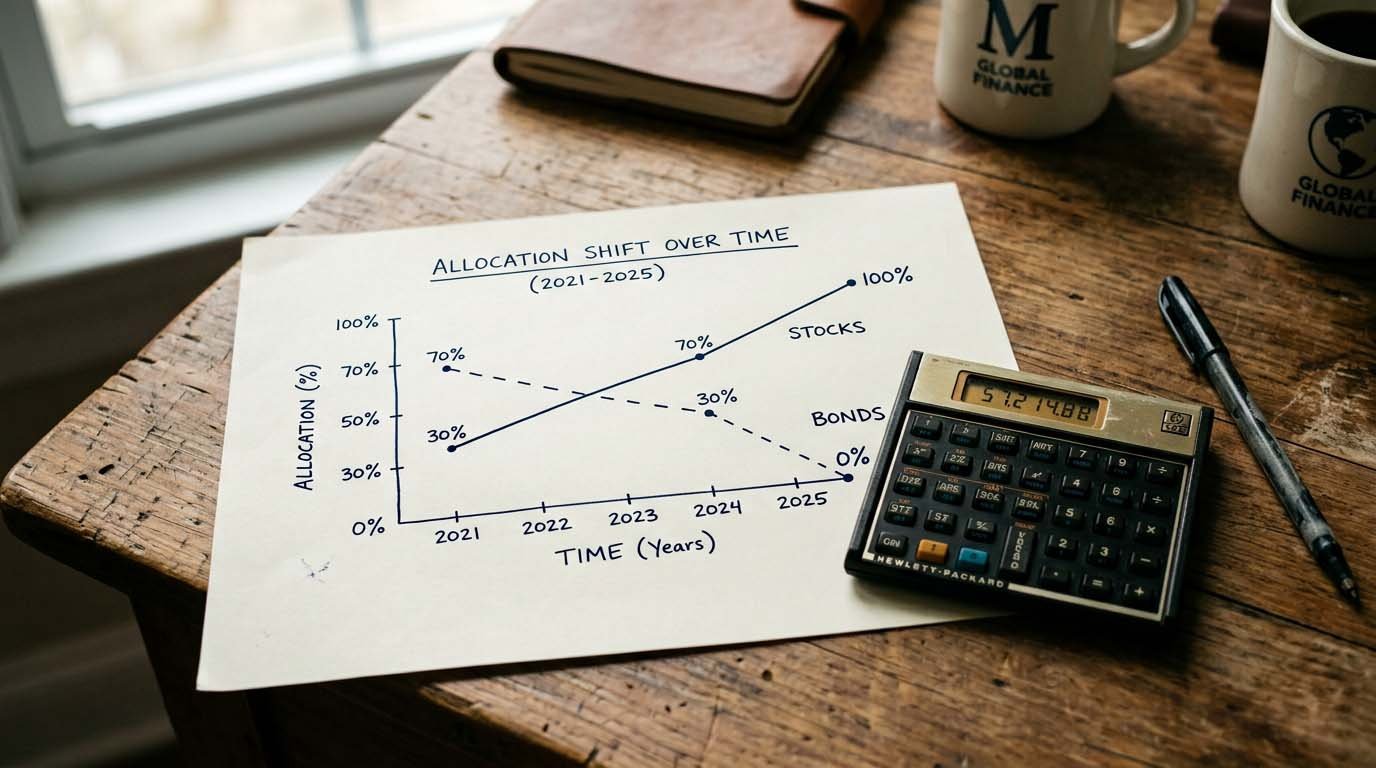
The single biggest factor in setting an allocation is how long the money needs to sit before you need it. Stocks carry short-term volatility. But they’ve historically recovered and grown over long periods. Money you won’t touch for 20 or 30 years can afford to ride out that volatility. There’s time to recover from a downturn.
Money you’ll need within the next few years is a different story. A market drop right before you need to withdraw funds can force you to sell at a loss. That locks in a decline you’d otherwise have time to wait out. This is why allocations typically shift toward bonds and cash as a goal gets closer. That applies whether the goal is retirement, a home purchase, or a child’s college tuition.
The old “110 minus your age” rule
A commonly cited rule of thumb suggests subtracting your age from 110. That gives you your stock allocation percentage, with the rest in bonds. A 30-year-old would hold 80% stocks. A 60-year-old would hold 50%. This kind of rule offers a simple starting point. But it treats age as the only variable that matters, which oversimplifies things for a lot of people.
Two 60-year-olds can have wildly different appropriate allocations. One might have a pension covering most expenses, along with room for a high tolerance for risk with the rest of their savings. Another might be relying entirely on their portfolio with no other income source at all. Age-based rules are a reasonable starting point. They’re not a substitute for thinking through your specific situation.
Risk tolerance vs risk capacity
These two terms get confused often, but they measure different things. Risk tolerance is emotional. It’s how much portfolio volatility you can handle without panicking and selling at the worst possible time. Risk capacity is financial instead. It’s how much volatility your actual situation can absorb. That’s based on your timeline, income, and other resources, regardless of how you feel about it.
A useful allocation accounts for both. Take someone with high risk capacity but low risk tolerance. That person might still choose a more conservative allocation. A portfolio they can’t stick with during a downturn defeats its own purpose. Or take the opposite case: high risk tolerance but low risk capacity, like a retiree relying entirely on their savings. That person should generally lean conservative anyway, regardless of how comfortable they feel with volatility.
Target-date funds do this automatically
For investors who don’t want to manage this decision manually, target-date funds handle asset allocation automatically. You pick a fund labeled with your approximate retirement year. The fund gradually shifts from stock-heavy to bond-heavy as that date approaches. This process follows what’s called a glide path.
These funds aren’t perfect for everyone. They apply a generic glide path rather than one tailored to your specific risk tolerance or other financial resources. But they solve the most common failure mode in DIY asset allocation. That failure mode is never rebalancing, or letting an allocation drift far from where it should be as the years pass. Our How to Build a Diversified Investment Portfolio guide covers rebalancing in more depth for investors managing their own mix.
How allocation shifts as a goal approaches

The general principle, whether managed manually or automatically through a target-date fund, is a gradual shift. Portfolios move from growth-focused to stability-focused as a goal nears. Someone 30 years from retirement might hold 90% stocks and 10% bonds. The same person 5 years from retirement might hold closer to 50% stocks and 50% bonds. By the time they’re actually retired and drawing down the portfolio, the mix often shifts further still. It usually doesn’t go all the way to zero stocks, though. Some growth exposure still helps a retirement portfolio last through a multi-decade withdrawal period. Our 4% Rule article covers how withdrawal strategy and allocation interact once you’re actually retired and drawing down savings.
A few example allocations by life stage
A 25-year-old saving for retirement decades away might reasonably hold 90% stocks and 10% bonds. Prioritizing growth makes sense here, since there’s ample time to recover from any downturn. Someone in their mid-40s, with a home, kids, and a retirement roughly 20 years out, might hold something closer to 75% stocks and 25% bonds, still growth-focused but with a bit more stability. By the time someone reaches their mid-60s and newly enters retirement, a 50/50 split between stocks and bonds is common. That balances continued growth against the need for near-term stability during withdrawals.
These are illustrative examples, not personalized recommendations. Someone’s actual number should reflect their specific timeline, other income sources, and comfort with volatility. It shouldn’t just reflect their age on a calendar.
Why allocation beats stock-picking for most people
It’s tempting to think that picking the right individual stocks matters more than the broad split between asset classes. In practice, the opposite tends to be true for most investors. Even skilled stock pickers struggle to consistently beat a simple, well-chosen allocation held over the long term, since individual stock selection introduces a level of unpredictability that a diversified allocation largely avoids.
This doesn’t mean individual stock selection never adds value. It means that for the vast majority of people building long-term wealth, the split between stocks, bonds, and cash does more heavy lifting than the specific securities chosen within each category. Getting the allocation right first, then filling it with low-cost, broadly diversified funds, tends to outperform the opposite approach of picking exciting individual stocks without a clear allocation plan behind them.
This is also why so much of professional financial planning starts with an allocation conversation rather than a stock-picking one. Advisors who understand a client’s timeline and risk tolerance can set a sensible allocation in a single meeting, while beating the market through stock selection alone remains extraordinarily difficult even for full-time professionals with access to research and data most individual investors will never have.
Common mistakes with asset allocation
Setting an allocation once and never revisiting it is one common mistake. Goals, timelines, and life circumstances change over time. Chasing last year’s best-performing asset class is another mistake. It tends to push investors into buying high after a run-up rather than sticking with a disciplined plan. Letting emotions drive allocation changes during a market downturn is a third. Selling stocks after they’ve already fallen locks in losses that a stable allocation would have avoided. Our Bear Market vs Bull Market article covers what the historical data shows about staying invested through downturns.
Set yours and revisit it periodically
There’s no universal correct allocation. The right mix depends on your timeline, your other resources, and how much volatility you can actually stick with during a downturn, not just ride out on paper. Our Investment Calculator and Retirement Calculator can help you model how different allocations might play out. You’ll be working from real projections rather than a generic age-based rule.
Common questions about asset allocation
Asset allocation is the split between broad categories, like stocks, bonds, and cash. Diversification is how spread out your holdings are within each category. Both matter, but they answer different questions about how your portfolio is structured.
Generally, yes, though the specific timing depends on your individual situation. Most investors gradually shift from a stock-heavy allocation toward more bonds and cash as they approach a goal like retirement, since the money will be needed sooner and has less time to recover from a downturn.
It can be, for a young investor with a very long time horizon and a high tolerance for volatility. It becomes riskier as a goal approaches, since there’s less time to recover from a market downturn before the money is needed.
A few more things worth knowing
A glide path is the gradual shift in asset allocation that target-date funds follow automatically, moving from stock-heavy to bond-heavy as the target date approaches. It’s designed to reduce risk as a goal nears without requiring manual adjustments.
Most guidance suggests reviewing it at least once a year, or after major life changes like a new job, marriage, or approaching retirement. Frequent adjustments based on short-term market moves usually do more harm than good.
For many investors, yes, since they automatically rebalance and shift the allocation over time without requiring any action. They use a generic glide path, though, so they may not perfectly match an individual’s specific risk tolerance or other financial resources.