How Is Credit Card Interest Calculated? The Daily Math Explained
Your credit card statement shows one interest charge for the month. But issuers don’t calculate it once a month. They calculate it every single day, then add it to your balance before the next day’s math even starts. That daily habit is why credit card debt grows faster than most people expect, and why two people with the same APR can end up paying very different amounts.
It starts with your APR, not a flat yearly number
Your card’s APR looks like a single annual figure, say 22%. But issuers never apply that number once a year. They break it down into a daily rate first. Take the APR, divide it by 365, and you get what’s called the daily periodic rate. A 22% APR works out to roughly 0.0603% per day. That number sounds tiny. Applied every day to a real balance, it adds up fast.
Our How Do Credit Cards Work? guide covers the bigger picture: billing cycles, grace periods, and what triggers interest in the first place. This article zooms in on the calculation itself, the part that actually determines your bill.
This daily approach makes credit card interest a form of compound interest, not simple interest. With simple interest, you’d owe a fixed percentage of your original balance each year. That percentage would never change, no matter how long the debt sat unpaid. Compound interest works differently. Interest gets added to your balance, and then future interest calculates off that larger number. Our Simple vs Compound Interest article covers the broader mechanics if you want to see how the two compare outside of credit cards specifically.
The formula issuers actually use
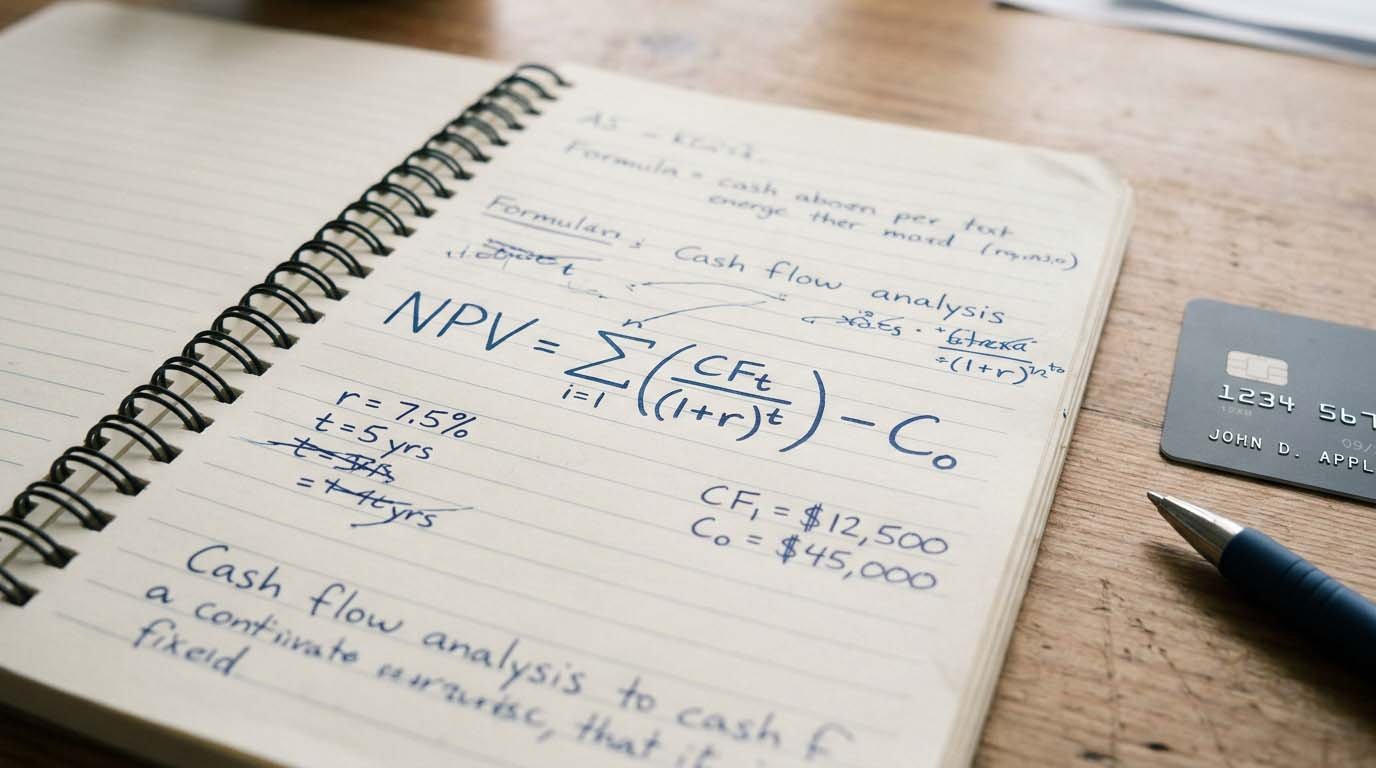
Most card issuers use the average daily balance method. Here’s how it works, step by step:
First, they take your daily periodic rate (APR divided by 365). Second, they track your balance at the end of every single day in the billing cycle. Third, they average all of those daily balances together. Fourth, they multiply that average by the daily periodic rate. Then they multiply again by the number of days in the cycle.
The result is your interest charge for the month. It sits on your statement as one lump number, but four separate calculations built it.
A worked example with real numbers
Say you start the month with a $2,000 balance on a card with a 24% APR. You make no new purchases and no payments until the due date. Your daily periodic rate comes out to 24% divided by 365, or about 0.0658%.
Your average daily balance stays flat at $2,000, since nothing changes during the cycle. Multiply $2,000 by 0.0658%, and you get roughly $1.32 in interest per day. Multiply that by a 30-day cycle, and your interest charge for the month lands around $39.45.
Now change one thing. Say you pay $1,000 halfway through that same 30-day cycle, on day 15. Your average daily balance drops to $1,500 instead of $2,000. That’s because the balance sat at $2,000 for half the cycle and $1,000 for the other half. That lower average cuts your interest charge to roughly $29.60 for the month — a real savings of about $9.85. That gain comes just from paying earlier rather than waiting until the due date.
Stretch that same $2,000 balance across three months with no payments at all, and the compounding effect becomes clearer. In month one, interest adds roughly $39.45, bringing the balance to $2,039.45. By month two, that higher number pushes the charge up to around $40.24. Month three then adds close to $41.04. The balance grows by more each month, even though the APR never changed. That’s because each month’s interest calculates against a slightly bigger number than the last.
Why paying early in the cycle beats paying late

That $9.85 difference points to something most people miss: timing matters, not just the amount you pay. Since issuers average your balance across every day of the cycle, an early payment lowers your average far more than a late one. A payment on day 3 beats the same payment on day 27. If you carry a balance and can’t clear it entirely, pay as early in the cycle as possible — even before your statement generates. That shrinks the average balance issuers use to calculate interest.
This is also why making two smaller payments during the month can save a small but real amount of interest, rather than one large payment at the due date. It won’t transform your finances, but it costs nothing to do and adds up over a year of statements.
Why minimum payments barely move the needle
Minimum payments usually run about 2% of your balance, or a flat dollar amount, whichever is higher. On a $2,000 balance at 24% APR, a 2% minimum payment is $40. Interest for that first cycle already ran close to $39, as shown above. Almost the entire minimum payment goes toward interest, not principal.
That’s the trap: the balance barely shrinks, so next month’s average daily balance stays almost as high, and the interest charge barely drops either. This cycle repeats for years on a large balance paid at the minimum. Some issuers set a minimum payment floor around $25 or $35 regardless of balance size. That helps small balances clear faster but does little for a balance in the thousands. Our How to Pay Off Credit Card Debt Faster guide covers strategies that break this cycle. Our Credit Card Payoff Calculator lets you plug in your own balance and APR to see exactly how many months different payment amounts actually take.
New purchases during a carried balance
If you’re carrying a balance from a previous cycle, new purchases usually start accruing interest immediately, with no grace period. The grace period only applies when you paid your entire previous statement balance in full. Once you carry any balance forward, every new swipe joins the average daily balance calculation from the day you make it. This is one reason financial advisors often suggest stopping new charges on a card entirely once you’re carrying interest-bearing debt on it.
What a penalty APR does to the calculation
Miss a payment by 60 days or more, and many issuers reserve the right to apply a penalty APR. That rate can run significantly higher than your normal rate. The formula itself doesn’t change. It’s still daily periodic rate times average daily balance times days in the cycle. What changes is the rate that goes into that formula. A higher rate means a higher daily periodic rate applied to the exact same balance. On a $2,000 balance, moving from a 22% APR to a 29.99% penalty APR roughly doubles the daily interest cost. Some issuers apply the penalty rate only to new purchases, while others apply it to your entire balance. So, it’s worth checking your card’s terms before assuming which applies.
How billing cycle length changes the total
Not every billing cycle runs the same number of days. Some months give you 28 days, others give you 31. Since the formula multiplies your average daily balance by the number of days in the cycle, a longer cycle means more days of interest accruing. That’s true even on the exact same balance. A $2,000 balance at 24% APR accrues about $1.32 per day. Over a 28-day cycle, that’s roughly $36.96 in interest. Over a 31-day cycle, the same balance accrues closer to $40.92. Nothing about your APR or your balance changed, only the calendar did.
This is a small effect on any single statement. But it explains why your interest charge can shift slightly from month to month, even when your spending habits stay identical.
Comparing cards on more than the headline APR
Two cards with the same advertised APR can still cost you differently. It depends on how often they compound and how they calculate your average balance. A card that uses the previous balance method, rather than average daily balance, can produce a different charge for the exact same spending pattern. Our APR vs Interest Rate article explains why the number on a card’s marketing material doesn’t always match what you’ll actually pay. If you’re deciding between a card and a personal loan, or comparing two card offers side by side, the APR Calculator can help. It puts both offers on equal footing. And if utilization is part of what’s driving your balance up in the first place, it’s worth checking too. Our Credit Utilization Explained article covers that angle alongside this one.
If a balance transfer to a lower-rate card makes sense for your situation, it’s worth exploring. Our Balance Transfer Cards guide walks through the math on when the transfer fee pays for itself.
None of these calculations require you to become an accountant. The core idea is simple even if the formula has several steps. Your balance, your APR, and how many days that balance sits unpaid are the only three inputs that matter. Lower any one of them, whether by paying earlier, paying more, or moving the balance to a lower rate. Your interest charge drops in response. Everything else on your statement is a variation on that same relationship.
Common questions about credit card interest
Issuers calculate it daily, using a daily periodic rate derived from your APR. They add that daily amount to your balance right away. Your statement then shows the total for the whole cycle as one combined number.
Yes. Since issuers average your daily balance across the entire cycle, an earlier payment lowers that average more than a later one. That’s true even for the exact same dollar amount. Paying down debt as soon as you’re able, rather than waiting for the due date, reduces the interest that accrues that month.
A minimum payment on a large balance often covers mostly interest, with very little going toward principal. Your balance barely shrinks, so next month’s average daily balance stays close to where it started, and the interest charge follows the same pattern.
A few more things worth knowing
Usually, yes. The grace period only applies when you pay your entire previous statement in full. Once any balance carries forward, new purchases join the average daily balance from the day you make them, with no interest-free window.
It’s the calculation most issuers use to figure out your monthly interest. They track your balance at the end of every day in the cycle, then average those daily figures. From there, they apply your daily periodic rate to that average across the full cycle.
Paying your full statement balance for one cycle typically restores your grace period going forward, so interest stops accruing on new purchases again. Any existing balance from before that point still needs to be paid off, and it will keep accruing interest until it reaches zero.