How Do Personal Loans Work?
A personal loan hands you a lump sum upfront, then asks for the same fixed payment every month until it’s paid off. That simplicity is the whole appeal. No revolving balance, no minimum payment games, no guessing what next month’s bill will look like. Here’s how the mechanics actually work, from approval to the last payment.

A lump sum, repaid in fixed installments
A personal loan is an installment loan. You borrow a fixed amount once, the lender deposits it into your account, and you repay it over a set term, usually two to seven years, through equal monthly payments. Each payment covers a mix of principal and interest, and that mix shifts slightly every month as the balance goes down.
The appeal is predictability. From the day you sign the loan agreement, you know exactly how much you’ll pay each month and exactly when the debt will reach zero, assuming you stick to the schedule. There’s no revolving temptation to spend more against the same limit, no minimum payment that barely dents the balance, and no rate that changes based on a promotional period ending.
This structure differs completely from a credit card. Our How Do Credit Cards Work? guide covers revolving credit in detail, but the short version is that a card lets you borrow, repay, and borrow again against the same limit. A personal loan doesn’t work that way. Once it’s funded, there’s no revolving line to draw from again. You just pay it down until it hits zero.
How the application and approval process works
Most lenders start with a soft credit check, which doesn’t affect your score, to give you a preliminary rate estimate. If you move forward with a full application, the lender runs a hard credit inquiry, which can cause a small, temporary dip in your score. Approval and the rate you’re offered depend on several factors: your credit score, your income, your existing debt relative to that income, and sometimes your employment history.
Once approved, funding typically arrives within one to five business days, often directly deposited into your bank account. Some lenders, particularly those offering debt consolidation loans, will pay your existing creditors directly instead of depositing funds to you.
What determines your rate
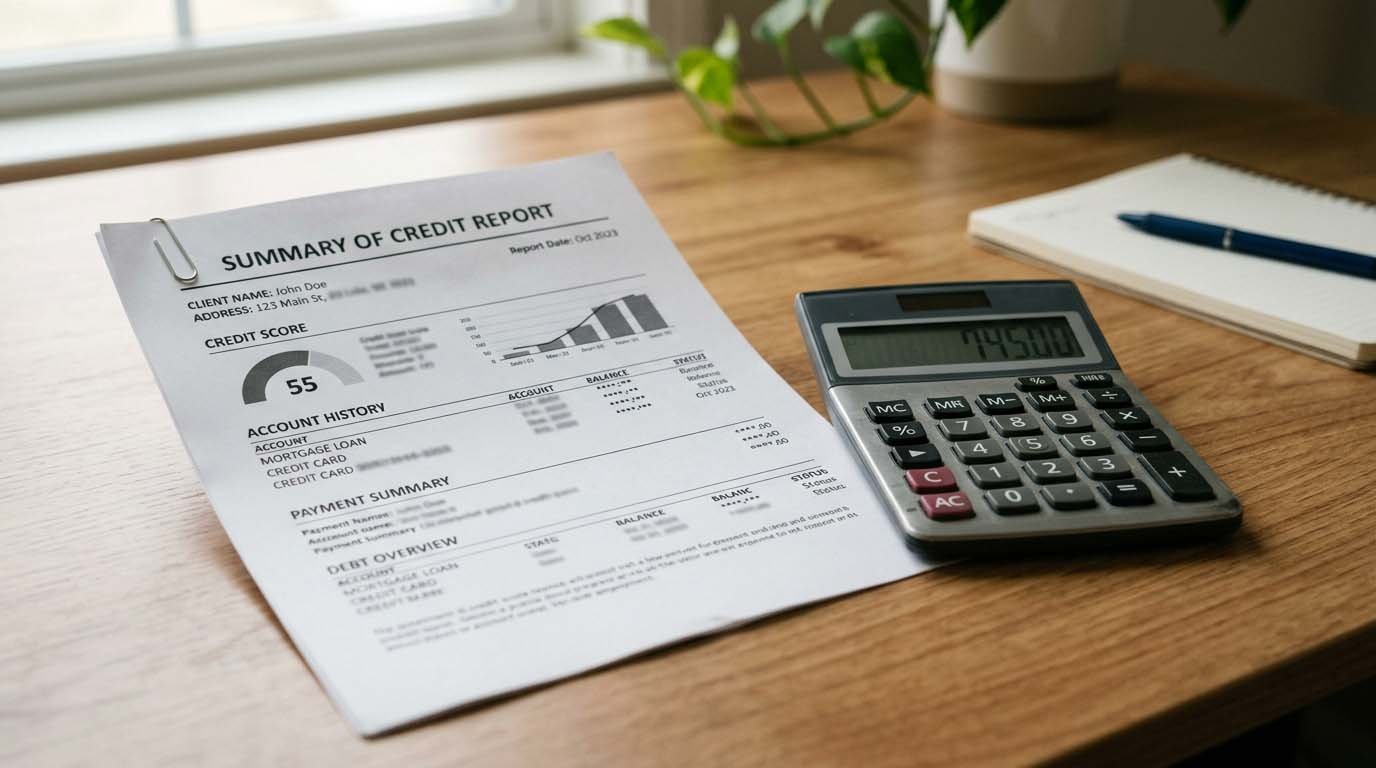
Your credit score plays the biggest role. Borrowers with excellent credit often qualify for rates in the single digits, while borrowers with fair or poor credit can see rates climb well above 20%, sometimes higher than a credit card’s APR. Loan term matters too. Shorter terms generally carry lower rates than longer ones, since the lender’s money is at risk for less time.
Your debt-to-income ratio, the share of your monthly income already committed to debt payments, also factors into both approval and pricing. A lower ratio signals more room in your budget to handle a new payment, which lenders reward with better terms. Some lenders also weigh your employment history and how long you’ve held your current job, since steady income reduces the perceived risk of default.
Our APR vs Interest Rate article covers why the number you’re quoted matters more once fees get factored in. Comparing two loan offers by their nominal interest rate alone can be misleading if one carries a bigger origination fee than the other.
Origination fees and what you actually receive
Many personal loans charge an origination fee, commonly 1% to 8% of the loan amount, deducted before the funds reach you. Borrow $10,000 with a 5% origination fee, and you’ll actually receive $9,500, while still owing interest on the full $10,000. This is why the APR, which factors in the origination fee alongside the interest rate, gives a more accurate picture of the loan’s true cost than the interest rate alone.
Not every lender charges an origination fee. Borrowers with strong credit sometimes qualify for loans with no fee at all, which is worth checking before assuming a fee is unavoidable. When comparing offers, always look at the APR rather than the interest rate alone, since two loans with identical interest rates can carry very different total costs once their fees are factored in.
Fixed vs variable rate personal loans
Most personal loans carry a fixed rate, meaning your interest rate and monthly payment stay the same for the entire term. Some lenders offer variable-rate loans instead, where the rate can rise or fall based on a benchmark index. Variable rates sometimes start lower than fixed rates, but they carry the risk of climbing over the loan’s term, which makes budgeting harder. For most borrowers seeking predictability, a fixed-rate loan removes that uncertainty entirely.
How the monthly payment gets calculated

Personal loans use amortization, meaning each payment covers both interest and principal, with the split shifting over time. Early payments go mostly toward interest. Later payments go mostly toward principal, even though the total payment amount never changes. This is the same structure used for auto loans and mortgages, just typically over a shorter term.
Say you borrow $10,000 at 11% APR over three years. Your monthly payment lands around $327. Over the life of the loan, you’ll pay roughly $1,772 in total interest, on top of the $10,000 you borrowed. Stretch that same loan to five years instead, and your monthly payment drops to around $217, but total interest climbs to roughly $3,033, since the balance sits outstanding for longer. Our Personal Loan Calculator lets you test different amounts, rates, and terms to see the exact trade-off for your situation.
Most personal loans allow early payoff without a prepayment penalty, which is a meaningful advantage over some other loan types. Paying extra whenever you have the cash to spare shortens the term and cuts the total interest, since amortization schedules recalculate the remaining balance every time a payment lands.
What personal loans are commonly used for
Debt consolidation is one of the most common uses, since replacing several high-interest credit card balances with a single fixed-rate loan payment can simplify finances and cut interest costs. Our Balance Transfer vs Personal Loan article compares this approach against transferring the balance to a new credit card instead. Home improvement projects, medical expenses, and major purchases are other common uses, since a personal loan doesn’t require collateral the way a home equity loan or auto loan does.
Some borrowers also use personal loans to cover moving expenses, wedding costs, or a large one-time bill that would otherwise sit on a credit card at a much higher rate. The common thread across all of these uses is a known, fixed cost that benefits from a predictable payment schedule, rather than an ongoing or unpredictable expense better suited to a revolving line of credit.
Secured vs unsecured personal loans
Most personal loans are unsecured, meaning no collateral backs the loan. If you stop paying, the lender can’t automatically seize an asset the way a mortgage lender could seize a house. Because of that added risk, unsecured personal loan rates tend to run higher than secured loan rates. Some lenders offer secured personal loans instead, backed by a savings account or another asset, typically in exchange for a lower rate. Our Secured vs Unsecured Debt article covers this trade-off in more depth, including what happens if a secured loan goes unpaid.
How this affects your credit score
Applying for a personal loan triggers a hard inquiry, causing a small, temporary dip in your score. Beyond that initial dip, a personal loan can actually help your score over time in a specific way: since it’s installment debt rather than revolving credit, it doesn’t factor into your credit utilization ratio the way a credit card balance does. Using a personal loan to pay off credit card debt can lower your utilization and give your score a modest boost, even though your total debt hasn’t changed. Adding an installment loan to your credit file can also diversify your credit mix, another minor factor some scoring models take into account. Our What Is a Credit Score? article explains how the different factors, including credit mix, weigh into the overall number.
If you don’t have much credit history yet, or your income alone doesn’t meet a lender’s requirements, some lenders allow a cosigner to strengthen the application. Our What Is a Cosigner? guide covers what that role actually involves and the risk it carries for the cosigner.
Check the numbers for your situation
The right loan amount, term, and rate depend entirely on your own numbers. Our Personal Loan Calculator shows the exact monthly payment and total interest for any combination you’re considering. If you’re comparing a personal loan against carrying debt on a credit card instead, our APR Calculator and Debt Payoff Calculator put the two paths on the same footing, using your real balance and rate rather than a generic example.
A personal loan isn’t automatically cheaper than any other form of credit, and it isn’t automatically the right move either. It’s simply a tool with a specific shape: a fixed amount, a fixed rate in most cases, and a fixed end date. Whether that shape fits your situation comes down to running your actual numbers, not assuming the loan will behave the way a generic example suggests.
Common questions about personal loans
There’s no universal minimum, since it varies by lender. Borrowers with scores in the good to excellent range typically qualify for the lowest rates. Some lenders work with fair or even limited credit histories, though usually at a higher rate to offset the added risk.
Usually not. Most lenders let you check your estimated rate through a soft credit check, which doesn’t affect your score. Your score only takes a small, temporary hit once you submit a full application, which triggers a hard inquiry.
Most personal loans allow early payoff without penalty, which can save you money on interest. Some lenders charge a prepayment penalty, so it’s worth checking the loan terms before assuming you can pay it off ahead of schedule at no extra cost.
A few more things worth knowing
A personal loan typically carries a lower rate, a fixed term, and a predictable payment. A credit card cash advance usually comes with a higher APR than regular purchases, starts accruing interest immediately with no grace period, and often includes a separate cash advance fee on top.
You’ll typically face a late fee, and the missed payment can appear on your credit report once it’s 30 days or more past due. Missing multiple payments can lead to default, which has a significant negative impact on your credit and may result in the debt being sent to collections.
It depends on how quickly you can pay off the balance. A balance transfer can cost less if you clear it within the 0% promotional window. A personal loan tends to work better for larger balances that would take longer than that window to pay off.