Nominal Return vs Real Return: The Gap Inflation Leaves Behind
Your brokerage statement says your portfolio gained 8% this year. That number is real, technically, but it’s not the number that tells you whether you actually got richer. For that, you need its quieter cousin: real return, the same gain after inflation has taken its cut.

Nominal Return vs Real Return, Defined
Nominal return is the plain percentage change in the dollar value of an investment: what you started with, what you ended with, no adjustments. If $10,000 grows to $10,800 in a year, the nominal return is 8%. It’s the number printed on statements, quoted in fund performance sheets, and used in almost every headline about “the market.” The nominal return vs real return distinction is exactly what separates that headline number from what actually happened to your money.
Real return takes that same 8% and subtracts out the effect of inflation. Prices for everything else were rising at the same time your money was growing, and that matters. Say inflation ran at 3% that year. Your money can now buy meaningfully less per dollar than it could twelve months earlier, even with more dollars sitting in the account. Real return answers the question nominal return can’t: did your purchasing power actually increase, or did it just look that way on paper?
The formula, quick version and exact version
Most people use the shortcut: Real Return ≈ Nominal Return − Inflation Rate. An 8% nominal return minus 3% inflation gives you a real return of roughly 5%. That’s close enough for most everyday comparisons, and it’s the version people usually reach for when talking about the gap.
The more precise formula accounts for the fact that inflation compounds too: Real Return = [(1 + Nominal Return) ÷ (1 + Inflation Rate)] − 1. Plugging in the same numbers: (1.08 ÷ 1.03) − 1 = 0.0485, or about 4.85%. The gap between the quick version (5%) and the exact version (4.85%) is small at low rates. It widens as either number climbs, which is why the precise formula matters more in high-inflation years or with double-digit returns.
Why the gap compounds against you over time
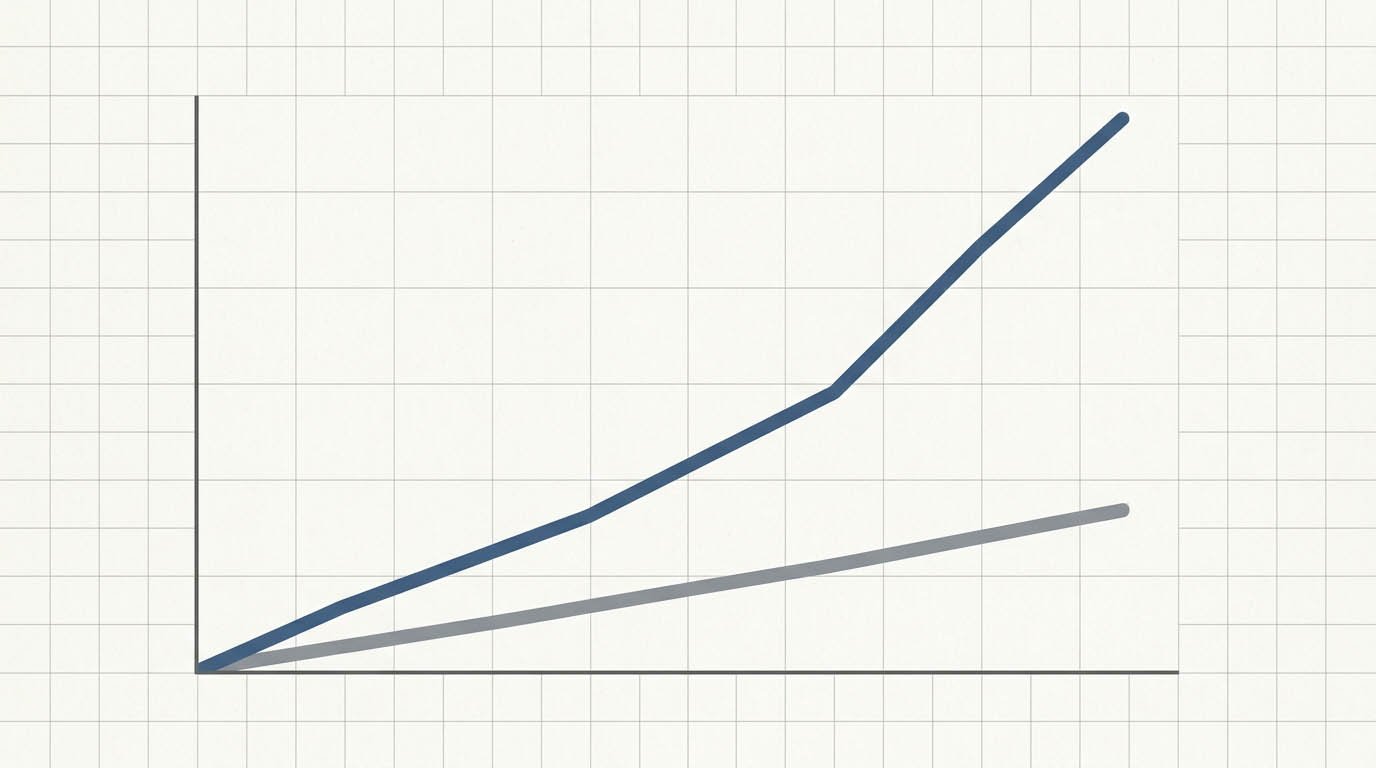
A single year’s gap between nominal and real return looks small. Stretch it across decades and it stops looking small. Take a savings account earning a steady 4% nominal return with inflation running at 3% every year for 20 years. That nominal balance on $10,000 grows to roughly $21,900. Its real, inflation-adjusted value, measured in today’s purchasing power, comes out closer to $12,000. On paper, the account statement shows more than double your money. Your actual buying power grew by about a fifth.
This is exactly why a savings account that feels safe can quietly lose you money in real terms. If your nominal rate sits below the inflation rate, even a growing account balance represents shrinking purchasing power, year after year, no market crash required.
Where this distinction actually bites
Bonds are the clearest example. A bond paying a fixed 4% coupon looks identical on paper whether inflation runs at 1% or 6%. But the real return investors pocket is wildly different in those two scenarios. This is also the entire reason Treasury Inflation-Protected Securities (TIPS) exist. They adjust their principal with inflation, specifically so their real return stays closer to the return the bond originally promised.
Savings accounts and CDs face the same math. Our high-yield savings guide covers nominal APYs. But the real question for any cash sitting in a bank account is whether that APY is outrunning inflation, not just whether it beats a competitor’s rate.
Wages work the same way, even though nobody calls a raise a “nominal return.” A 3% raise in a year when prices rose 4% is a real pay cut, even though the number on the paycheck went up. This is part of why Social Security includes a Cost-of-Living Adjustment (COLA) tied to inflation. The COLA exists to keep real benefits roughly flat, rather than letting inflation erode them year after year.
Taxes make the real number worse, not better
Taxes apply to nominal return, not real return, which makes the gap even wider than it first appears. The IRS taxes your $800 gain on that $10,000 example, not some inflation-adjusted version of it. The sequence runs like this: start with a nominal return, subtract taxes on that full nominal amount, then subtract inflation on what’s left. Each step chips away independently, and none of them cancel each other out.
This stacking effect is one reason cash sitting in a low-yield account can lose real value even when the account “grows” every single year on the statement. The nominal number goes up. Taxes take a bite of that nominal number. Inflation erodes what’s left. Three separate reductions apply to three different bases, and only one of them, the account balance, is visible without doing the math yourself.
A side-by-side example
Say you’re comparing two years for the same portfolio. Year one: 9% nominal return, 2% inflation. Year two: 6% nominal return, 1% inflation. On the nominal numbers alone, year one looks better, 9% beats 6%. This is the nominal return vs real return question in miniature: which year actually left you better off?
Run the real return instead. Year one: (1.09 ÷ 1.02) − 1 ≈ 6.86%. Year two: (1.06 ÷ 1.01) − 1 ≈ 4.95%. Year one still wins, but the gap shrank from 3 full points to under 2, because more of year one’s headline return was actually just inflation passing through. In a different pair of years, a lower nominal return paired with much lower inflation can beat a higher nominal return eaten up by high inflation. The nominal number alone can’t tell you which case you’re in.
Check your own numbers

Want to see what a nominal return is actually worth after inflation? Our Inflation Calculator converts a past or future dollar amount into today’s purchasing power, which does the same underlying job as the real return formula above. Projecting a portfolio forward instead? Our Investment Calculator and CAGR Calculator both let you model growth at a specific annualized rate. Just remember to compare whatever result you get against inflation before calling it good news. Running your own nominal return vs real return comparison takes a couple of minutes, and it’s the single best way to know where you actually stand.
Common questions about nominal vs real return
Real return, if you’re trying to judge whether you’re actually building wealth. Nominal return still matters for practical things like taxes, since it’s the number the IRS uses, and for tracking your account balance day to day. But for comparing your progress against your actual goals, like retirement or a future purchase, real return is the honest number.
Yes, and it happens more often than people expect. Any time inflation runs higher than your nominal return, your real return is negative, meaning your money grew in dollar terms but shrank in purchasing power. A savings account paying 1% during a year with 4% inflation is a common example.
Most calculations use the Consumer Price Index (CPI), which the U.S. Bureau of Labor Statistics publishes monthly. It tracks price changes across a broad basket of everyday goods and services. Our Consumer Price Index guide covers how that number comes together and what it does and doesn’t capture.
A few more things worth knowing
At low, everyday rates, the gap between Nominal − Inflation and the exact compounding formula is small, often less than half a percentage point. At higher rates, like double-digit nominal returns or high-inflation periods, the gap widens enough that it’s worth using the precise formula instead of the shortcut.
Not by itself. Real return only adjusts for inflation. Taxes are a separate reduction that applies to your nominal gain before inflation even enters the picture. For the truest sense of what you kept, calculate an after-tax nominal return first, then adjust that number for inflation.
A traditional bond locks in a fixed coupon at issuance, so unexpected inflation directly erodes its real return with no offset. Stocks represent ownership in businesses that can, at least sometimes, raise prices and grow revenue alongside inflation. That gives them more of a built-in cushion, though not a guaranteed one.