What Is Tax-Loss Harvesting?
Nobody likes watching an investment drop in value. But a loss on paper isn’t a total waste. Understanding what is tax-loss harvesting can turn that same losing position into a real reduction on your tax bill. Done right, it doesn’t require changing your long-term investment plan at all.

The short answer
Tax-loss harvesting means selling an investment that’s lost value, on purpose, so you can use that loss to lower your tax bill. The loss offsets capital gains from other investments you sold at a profit. If your losses are larger than your gains, a portion can even offset your ordinary income. None of this requires selling out of the market entirely.
It sounds counterintuitive at first. Nobody wants to lock in a loss. But this isn’t about giving up on an investment strategy. It’s a tax technique layered on top of decisions you might make anyway. Understanding what is tax-loss harvesting really means understanding how the IRS treats gains and losses together, not separately.
How it actually works, step by step
Say you own two stocks. One is up $8,000 since you bought it. The other is down $5,000. If you sell the winner alone, you owe tax on the full $8,000 gain. But if you also sell the loser in the same tax year, that $5,000 loss offsets part of the gain. Now you only owe tax on $3,000, not $8,000.
This process, pairing a realized loss against a realized gain, is the entire mechanism behind tax-loss harvesting. You’re not avoiding tax forever. You’re reducing what you owe this year, based on losses that already happened whether you harvested them or not. Our What Is Capital Gains Tax? guide covers how gains get taxed in the first place. That’s useful background if you’re new to this topic.
The $3,000 rule for offsetting ordinary income
Losses don’t have to stop at canceling out gains. If your total losses for the year exceed your total gains, you can use up to $3,000 of that excess to reduce your ordinary taxable income, like wages or salary. This applies to most filing statuses. Married couples filing separately are limited to $1,500 each.
That $3,000 figure hasn’t changed in decades and isn’t adjusted for inflation, so it buys less relative value than it once did. Still, for an investor with a large net loss, it’s a real deduction. It shows up directly on your tax return, reducing the income the IRS taxes you on for the year.
Carrying losses forward when you have more than you need
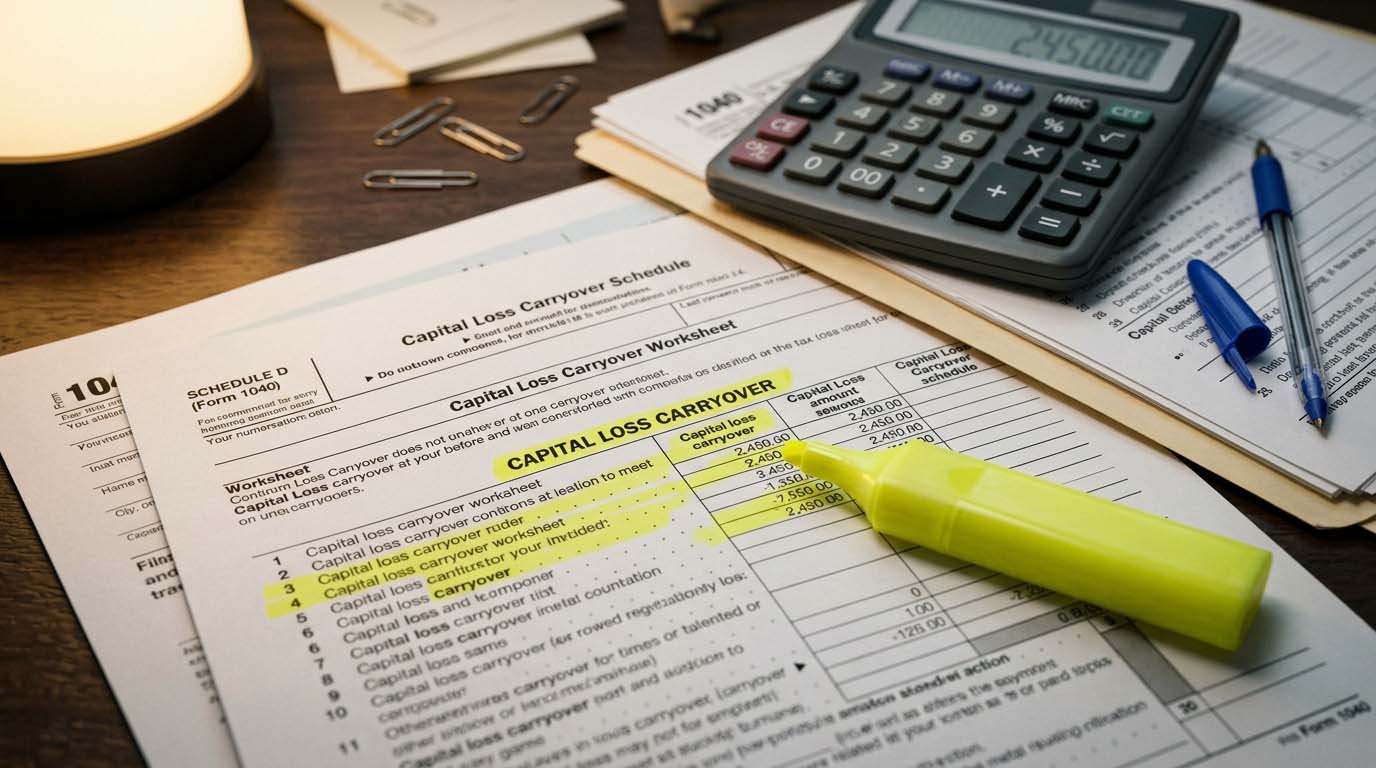
What happens if your losses are bigger than $3,000 plus all your gains combined? Nothing gets wasted. Any leftover loss carries forward into future tax years indefinitely, until it’s fully used up. A large loss from a bad year can keep offsetting gains and reducing income for years afterward.
This is one reason a rough year in the market isn’t purely bad news from a tax perspective. An investor who harvests a large loss during a downturn may be sitting on a tax asset that quietly reduces bills for several years to come, long after the market itself has recovered.
The wash sale rule: what you can’t do
Here’s the catch that trips people up most often. You can’t sell an investment at a loss and immediately buy back the same, or a “substantially identical,” investment and still claim the loss. The IRS calls this a wash sale, and it disallows the deduction entirely if it happens.
The window is 30 days before and 30 days after the sale, 61 days total. Buy the same stock back anywhere inside that window, and the loss gets disallowed. This applies across every account you own, including a spouse’s account or your IRA. Many investors get around this by buying a similar but not identical investment instead, like a different fund tracking the same index. That keeps them invested in the market while the wash sale window passes.
Why this often happens near year-end
Tax-loss harvesting can technically happen any time during the year. But it clusters heavily in November and December for a simple reason. By year-end, investors usually know their full picture of gains and losses for the year. There’s still time to act before the tax year closes on December 31.
This creates a well-documented pattern sometimes called “tax-loss selling season,” where losing positions see extra selling pressure late in the year. Some investors deliberately wait until January to buy back into a similar position, both to respect the wash sale window and to avoid buying into the seasonal selling pressure themselves.
The flip side: tax-gain harvesting
Less well known, but worth mentioning, is the mirror strategy. It works for investors in the 0% long-term capital gains bracket for the year. That bracket covers taxable income up to $49,450 for single filers, or $98,900 for married couples in 2026. Inside it, you can sometimes sell winning positions at a gain and owe no federal tax at all. Our Short-Term vs. Long-Term Capital Gains guide explains how those brackets work in more detail.
This is less common than loss harvesting, since it only applies at lower income levels. But it can be a useful way to reset your cost basis higher without paying tax on the gain. The wash sale rule doesn’t apply here, either. You can buy the same investment right back after selling for a gain.
A worked example
Picture an investor with a $12,000 gain from selling one stock, and a separate position down $9,000 for the year. Selling the losing position realizes that $9,000 loss. It offsets most of the $12,000 gain, leaving only $3,000 subject to capital gains tax instead of the full amount. That’s a meaningful reduction from a single decision made before the tax year closes.
If that same investor also had another position down $6,000, harvesting both losses would fully offset the $12,000 gain. That leaves $3,000 in excess loss. That extra $3,000 could then reduce ordinary taxable income for the year, using the rule described earlier. Nothing about the investor’s actual portfolio strategy needs to change. The tax outcome improves simply by realizing losses that already existed on paper.
Where this fits into a broader plan
Tax-loss harvesting works best as a habit, not a one-time event. Reviewing your taxable brokerage account for losing positions a few times a year can add up to meaningful savings over time. This matters especially before December 31, when the tax year closes. Index funds and ETFs make this easier, since similar funds tracking different indexes let you harvest a loss without stepping too far outside your intended asset allocation. Our Index Funds vs. Mutual Funds guide covers how those options compare if you’re building a portfolio with this kind of flexibility in mind.
It’s worth noting this only applies to taxable brokerage accounts. Losses inside a Roth IRA or traditional IRA can’t be harvested this way. Gains and losses inside those accounts simply aren’t reported on your tax return the same way. Our Roth vs. Traditional IRA guide covers how those accounts are taxed instead.
Why some investors let software handle it
Manually tracking every position for harvesting opportunities takes real effort, especially in a portfolio with many holdings. This is one reason automated tax-loss harvesting has become a standard feature at several robo-advisors and brokerage platforms. The software scans your account daily, looking for positions that have dropped below their purchase price, so nothing gets overlooked between your own periodic check-ins.
When it finds one, it can automatically sell the losing position and buy a similar, but not substantially identical, replacement fund. This keeps your portfolio’s overall market exposure roughly the same while still banking the loss for tax purposes. It also helps investors avoid triggering a wash sale by accident, since the software tracks every purchase and sale date across the account automatically. For a smaller portfolio, doing this manually once or twice a year is usually enough. For a larger, more complex portfolio, automated harvesting can capture opportunities a person checking in occasionally would likely miss.
Run your own numbers before you sell

What is tax-loss harvesting worth in your own situation? That depends entirely on your specific gains, losses, and tax bracket for the year. Our Investment Calculator can help you project how a position might grow if you reinvest the tax savings from a harvested loss, rather than spending it. If you’re weighing whether to sell a losing position now or hold it longer, our ROI Calculator lets you compare the after-tax outcome of each path.
This article is educational, not tax advice. The wash sale rule in particular has enough nuance that a tax professional’s input is worth the cost for a large portfolio. But reviewing your positions before year-end costs nothing. For many investors it’s one of the simplest ways to lower a tax bill without changing their underlying investment thesis.
Common questions about tax-loss harvesting
It’s selling an investment at a loss on purpose, so that loss can offset capital gains from other investments and lower your tax bill. Any leftover loss beyond your gains can reduce up to $3,000 of ordinary income each year, with the rest carried forward.
It’s an IRS rule that disallows a tax loss if you buy the same, or a substantially identical, investment within 30 days before or after the sale. The disallowed loss gets added to the cost basis of the new position instead of being deducted right away.
No. Tax-loss harvesting only applies to taxable brokerage accounts. Gains and losses inside a 401(k), traditional IRA, or Roth IRA aren’t reported on your tax return the way they are in a taxable account, so there’s nothing to harvest.
A few more things worth knowing
Not necessarily. Even in a rising market, individual positions can be down while your overall portfolio is up. Reviewing each position separately, rather than just your total portfolio value, is how most harvesting opportunities get found.
Unused losses carry forward to future tax years indefinitely. They don’t expire, and you can keep applying them against gains, or up to $3,000 of ordinary income per year, until the full loss is used up.
It depends on the size of your positions and gains for the year. For a small account with modest gains, the savings may be minor. For a larger taxable portfolio with meaningful realized gains, even a modest harvested loss can meaningfully reduce that year’s tax bill.