Bond Price vs Yield: Why Do They Move in Opposite Directions?
Bond prices go up, and yields go down. Bond prices go down, and yields go up. This relationship confuses a lot of new investors, since it seems backward at first. Once you see the mechanism behind it, the logic becomes obvious. Here’s why the two move in lockstep, just pointed opposite ways.
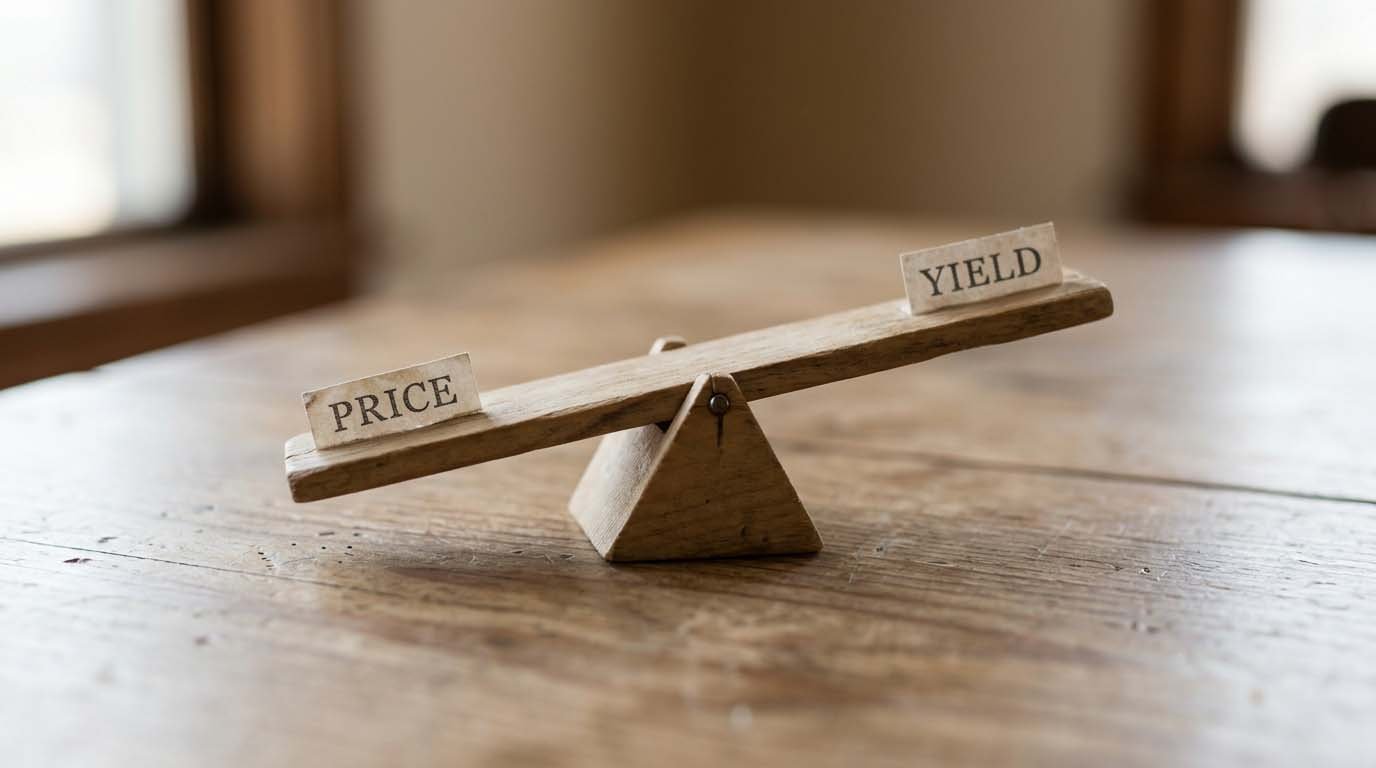
Two numbers, opposite directions
A bond’s price is what you’d pay to buy it on the open market today. A bond’s yield is the return an investor actually earns, based on that price and the bond’s fixed interest payments. Our What Is a Bond and How Does It Work? article covers the basic mechanics of bonds if you need a refresher before diving into this relationship.
When a bond’s price rises, its yield falls. When its price falls, its yield rises. This isn’t a coincidence or a market quirk. It’s baked directly into the math. A bond’s fixed payments interact with whatever price you paid to get them, and that math always points in opposite directions.
Why a fixed coupon makes this happen
A bond’s coupon payment is fixed in dollar terms once the bond is issued. A $1,000 bond with a 5% coupon pays exactly $50 a year, no matter what happens to the bond’s market price afterward. Yield, though, measures that fixed payment as a percentage of what you actually paid for the bond. It’s not measured against the original face value.
Pay less than face value for that bond, and the same $50 payment represents a larger percentage return on your smaller investment. That pushes yield up. Pay more than face value, and that same $50 represents a smaller percentage return on your larger investment. That pushes yield down. The dollar amount never changes. What changes is the price you paid to receive it.
A worked example with real numbers
Take that same $1,000 bond with a $50 annual coupon, a 5% coupon rate. If you buy it at face value, $1,000, your yield equals the coupon rate exactly: 5%. Now say the bond’s market price drops to $900. That same $50 payment, divided by the new $900 price, works out to roughly 5.6% yield. The price fell, and the yield rose.
Flip it around. Say the bond’s market price rises to $1,100 instead. That same $50 payment, divided by the new $1,100 price, works out to roughly 4.5% yield. The price rose, and the yield fell. Same bond, same $50 coupon payment. The completely different yield came purely from what you paid to get it.
What drives bond prices up and down
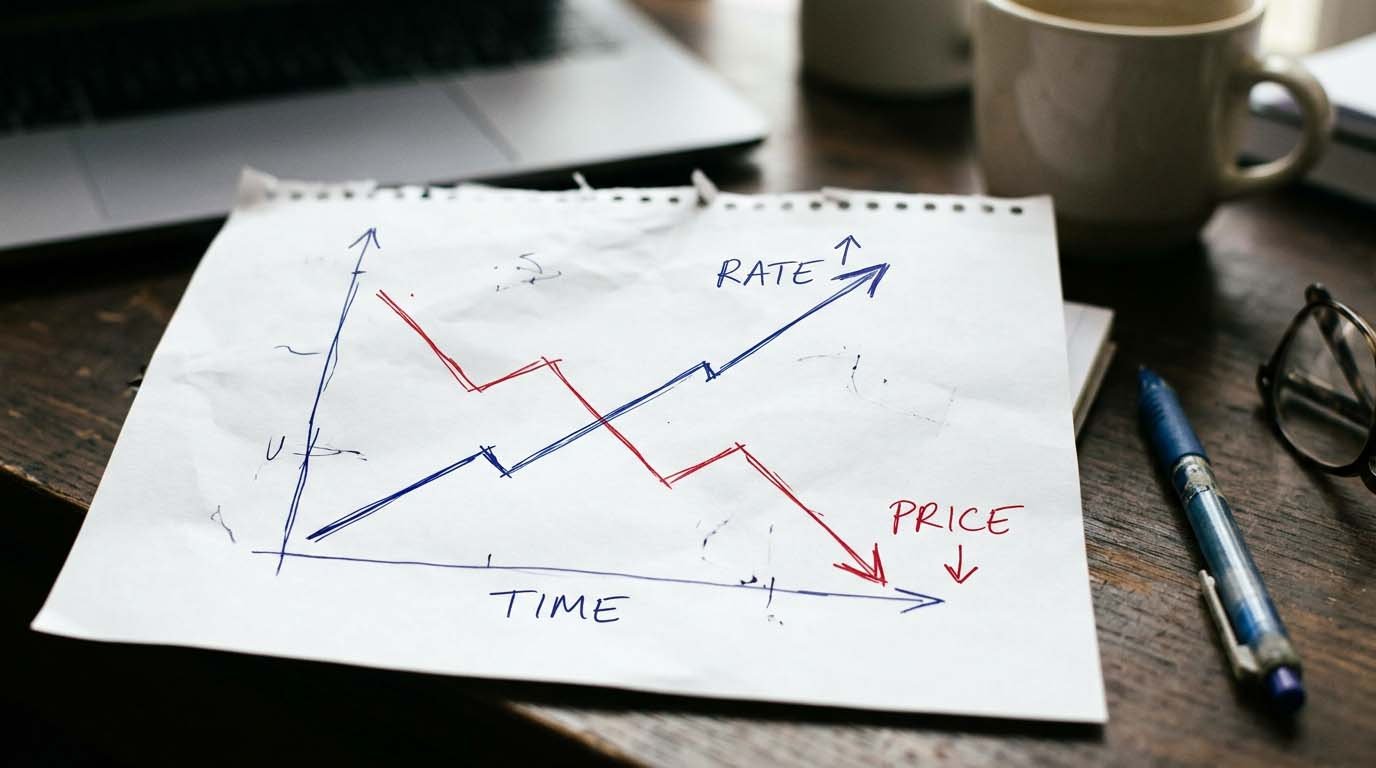
The single biggest driver of bond prices is prevailing interest rates. When new bonds get issued at higher rates than an existing bond’s coupon, that existing bond becomes less attractive by comparison. Its price falls to compensate. That pushes its yield up to match newer, more competitive bonds. When new bonds get issued at lower rates, the existing bond with its higher coupon becomes more attractive instead. Its price rises, pushing its yield down. This constant repricing is why bond markets react so quickly whenever a central bank signals a rate change is coming.
Credit quality changes can move prices too. If a bond issuer’s financial health improves, its bonds become more attractive and prices tend to rise. If an issuer’s outlook worsens, prices tend to fall as investors demand a higher yield to compensate for the added risk. This is separate from the interest rate effect described above, and both can happen at once, sometimes pulling a bond’s price in the same direction and sometimes offsetting each other.
Yield to maturity vs current yield
Current yield, the calculation used in the examples above, simply divides the annual coupon by the current price. Yield to maturity is a more complete measure. It accounts for the current yield plus any gain or loss you’d realize if you held the bond until it matures and received the full face value back.
Buy a bond below face value, and yield to maturity runs higher than current yield. You’ll also gain the difference between your purchase price and the face value at maturity. Buy above face value, and yield to maturity runs lower than current yield instead. You’ll lose that difference when the bond matures at face value. Most bond listings show yield to maturity as the primary figure, since it captures the complete picture of your expected return.
Why this matters if you sell before maturity
If you plan to sell a bond before it matures, price and yield movements directly affect what you’ll actually receive. Sell during a period when rates have risen since you bought the bond, and you’ll likely receive less than you paid. Your bond’s fixed coupon now looks less attractive next to newer, higher-yielding bonds. Sell during a period when rates have fallen instead, and you might receive more than you paid, since your bond’s coupon now looks relatively attractive.
Why it doesn’t matter if you hold to maturity
Here’s the part that eases a lot of investor anxiety. If you hold a bond until it matures, and the issuer doesn’t default, none of this price fluctuation changes what you actually receive. You collect your coupon payments on schedule and get your full face value back at maturity. This holds regardless of what happened to the bond’s market price in between. Price swings only matter to investors buying and selling on the secondary market, not to those holding to maturity.
How this plays out with rising interest rates
When a central bank raises interest rates, newly issued bonds typically carry higher coupon rates than existing bonds issued before the increase. This makes older, lower-coupon bonds less competitive. Their prices fall on the secondary market as a result. Bondholders who need to sell during this period can see real losses, even though the bond itself hasn’t defaulted or changed in any way. Longer-maturity bonds tend to feel this effect more sharply than shorter-maturity ones, since there’s more time for the rate gap to matter.
A second example: falling rates
The relationship works in reverse too. Say rates fall after you buy a bond, and newly issued bonds now carry lower coupons than yours. Your existing bond, with its relatively higher fixed coupon, becomes more attractive to other investors. Its price rises on the secondary market, and its yield falls to match the new, lower prevailing rates. This is exactly why bond funds sometimes post gains during periods of falling interest rates. Nothing about the underlying bonds’ coupon payments has actually changed.
Why maturity length changes the size of the swing
Not every bond reacts to rate changes the same way. A bond with a short time left until maturity feels less price movement from a rate change than a bond with decades left. This makes intuitive sense. A bond maturing next year quickly returns your principal regardless of where rates go. A bond maturing in 20 years locks you into its fixed coupon for a much longer stretch. That gives rate changes more time to matter.
This sensitivity has a name: duration. Our What Is Bond Duration? article covers how to measure a specific bond’s price sensitivity to rate changes, which is a more precise tool than simply looking at maturity length alone. In general, though, longer-maturity bonds swing more in price for a given rate change than shorter-maturity ones. That’s worth keeping in mind when choosing between bonds of different lengths.
How this shows up in everyday bond funds
Most individual investors encounter this price-yield relationship indirectly, through bond funds rather than individual bonds. A bond fund’s share price moves up and down based on the combined price movements of all the bonds it holds. When rates rise broadly across the market, most bond funds see their share price dip. This happens even to funds holding high-quality, low-default-risk bonds. It can surprise investors who assumed bonds were simply “safe” and never expected to see a fund’s value decline.
The mechanism is the same one covered throughout this article, just applied across a basket of bonds rather than one at a time. A fund’s underlying holdings still pay their coupons on schedule. What changes is the fund’s current market value. That reflects what those bonds would sell for today, not what they’ll eventually pay out at maturity.
What to watch if you’re buying bonds now
Before buying any bond, check both its current yield and its yield to maturity, not just its stated coupon rate. Consider your own timeline too. If you’re confident you’ll hold to maturity, day-to-day price swings matter far less than if you might need to sell early. Our How Interest Rates Affect Bond Prices article goes deeper into the mechanics behind rate-driven price swings. Our What Is Bond Duration? article explains how to measure a specific bond’s sensitivity to rate changes before you buy.
Common questions about bond price and yield
Existing bonds carry a fixed coupon rate set when they were issued. When new bonds come out with higher rates, older bonds with lower rates become less attractive by comparison, so their price falls until their yield matches what newer bonds offer.
No. If you hold a bond to maturity and the issuer doesn’t default, you’ll still receive your scheduled coupon payments and your full face value back, regardless of how the bond’s market price moved in between.
Coupon rate is fixed at issuance and never changes. Yield reflects your actual return based on the price you paid, which can differ significantly from the coupon rate depending on whether you bought above or below face value.
A few more things worth knowing
Not necessarily. A higher yield can reflect a lower price due to falling demand or rising rates, but it can also reflect higher credit risk. It’s worth checking why a bond’s yield is elevated before assuming it’s simply a better deal.
Current yield only divides the annual coupon by the current price. Yield to maturity accounts for that plus any gain or loss you’d realize by holding the bond until it matures at face value, giving a more complete picture of expected return.
Often, yes, at least temporarily. Bond funds hold many individual bonds, and rising rates typically push those bonds’ prices down on the secondary market, which shows up as a lower fund value, even though the underlying bonds haven’t defaulted.