What Is Portfolio Rebalancing?
You pick an allocation, set it, and walk away. A few years later, without touching a thing, that allocation looks completely different. Stocks grew faster than bonds. Your risk level quietly crept up along with them. Rebalancing pulls it back to where you meant it to sit.

Your allocation drifts even if you do nothing
Say you build a portfolio at 70% stocks and 30% bonds. You never touch it again. Stocks tend to grow faster than bonds over time, though not every year. After a strong five-year stretch for the stock market, that same portfolio might sit at 80% stocks and 20% bonds. Nothing you did caused this shift. The market did it for you. Your stock holdings simply grew faster than your bond holdings. This is true even if you never made a single trade, which is part of what makes allocation drift so easy to miss until you actually check the numbers.
This drift matters because it quietly changes your risk level. Our What Is Asset Allocation? article covers why that stock-bond split matters so much in the first place. Rebalancing is the maintenance step that keeps your actual allocation close to the one you originally chose. Without it, the market decides your risk level instead of you.
How rebalancing actually works
Rebalancing means adjusting your holdings back to your target allocation. In its simplest form, that means selling a portion of whatever has grown beyond its target percentage. You then use the proceeds to buy more of whatever has fallen below its target. Using the earlier example, you’d sell enough stocks to bring that 80% back down to 70%. Then you’d use the proceeds to buy bonds until they’re back up to 30%.
This process forces a specific discipline. You’re selling the asset that’s currently performing well. You’re buying the one that’s currently lagging. That runs against every emotional instinct most investors have, which is exactly why rebalancing works as well as it does.
Calendar-based vs threshold-based rebalancing
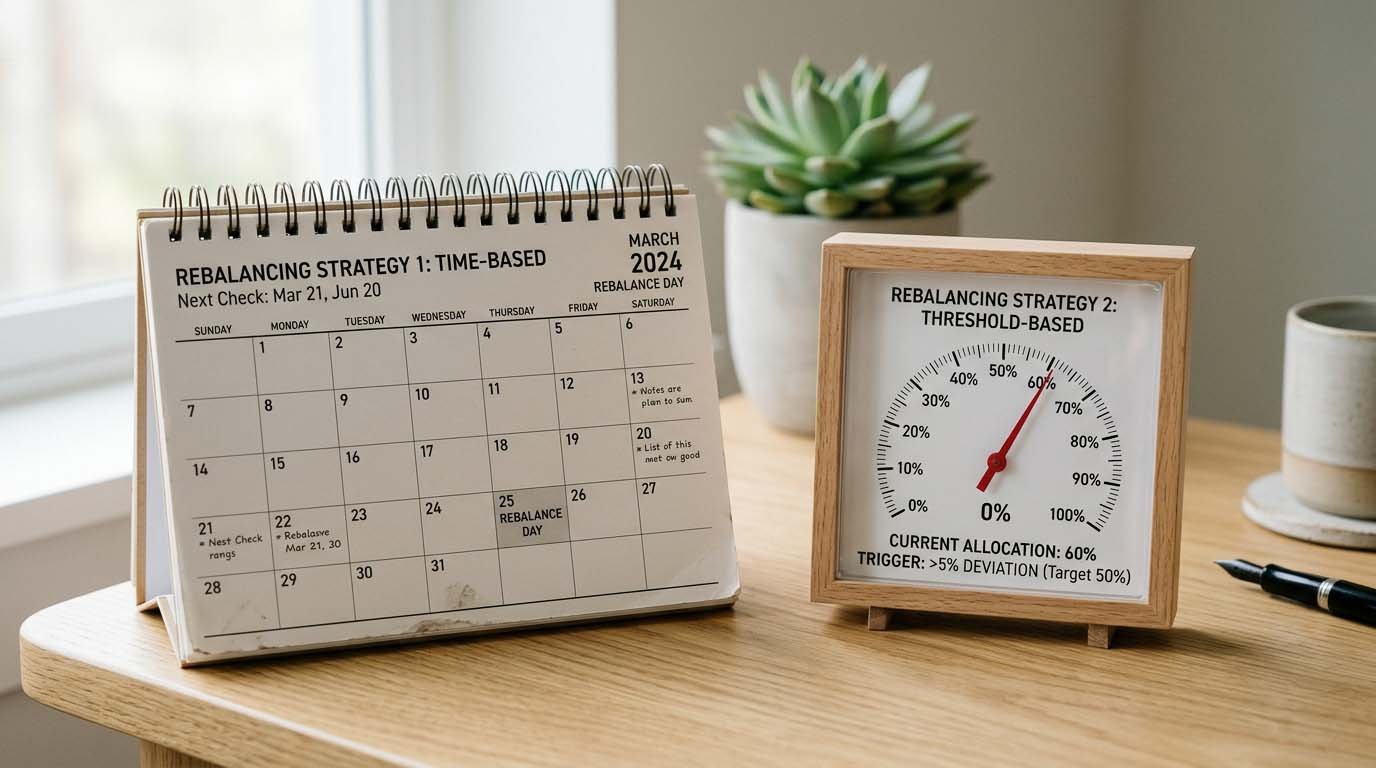
There are two common approaches. Calendar-based rebalancing means checking and adjusting your portfolio on a set schedule, commonly once a year or once a quarter. This happens regardless of how far the allocation has drifted. Threshold-based rebalancing instead triggers a rebalance only when an asset class drifts a set percentage away from its target, such as five percentage points. This method checks more frequently but acts only when drift is significant.
Neither method is objectively superior. Calendar-based rebalancing is simpler and easier to remember. Threshold-based rebalancing responds more precisely to actual market moves, but requires more frequent monitoring. Many investors combine both. They check on a calendar schedule, but only actually rebalance if the drift exceeds a chosen threshold at that check-in.
A worked example with real numbers

Start with a $100,000 portfolio at a target of 70% stocks and 30% bonds. That’s $70,000 in stocks and $30,000 in bonds. After a strong year, stocks grow to $85,000 while bonds hold steady at $31,000. The total portfolio now sits at $116,000. Stocks represent about 73% of that total instead of 70%.
To rebalance back to target, you’d want $81,200 in stocks, which is 70% of $116,000. You’d want $34,800 in bonds, the remaining 30%. That means selling roughly $3,800 worth of stocks and using the proceeds to buy the same amount in bonds. The dollar amounts here are modest, but the principle scales up with larger drifts and larger portfolios.
The behavioral benefit nobody talks about
Rebalancing gets framed mostly as a risk-management tool, and that’s accurate. But it carries a second, less discussed benefit. It systematically forces you to buy low and sell high, without requiring you to predict anything about the market. You’re not guessing when stocks have peaked or bonds have bottomed. You’re simply trimming whatever has grown and adding to whatever hasn’t, on a schedule you set in advance, well before emotions have a chance to take over the decision.
This removes a huge amount of the emotional decision-making that derails so many investors during volatile periods. Our Bear Market vs Bull Market article covers how panic selling during a downturn tends to lock in losses. Rebalancing, by contrast, gives you a structured reason to buy more of whatever’s currently out of favor. That’s usually the opposite instinct panic produces.
Taxable vs tax-advantaged accounts
Rebalancing inside a 401(k), IRA, or other tax-advantaged account triggers no tax consequences. You’re simply moving money between funds within the same shielded account. Selling a winner and buying a laggard costs you nothing beyond any trading fees. Our 401(k) vs IRA and Roth vs Traditional IRA articles cover these account types in more depth if you’re deciding where to hold your investments in the first place.
Rebalancing inside a regular taxable brokerage account works differently. Selling an appreciated position can trigger capital gains taxes, which eats into the benefit of rebalancing. This doesn’t mean you should avoid rebalancing taxable accounts. It means the mechanics deserve more thought, since a poorly timed rebalance can create an unwanted tax bill.
Using new contributions to rebalance
A simpler approach for taxable accounts, and one that works well in any account type, is directing new contributions toward whichever asset class has fallen behind its target, rather than selling anything at all. If bonds have drifted below their target percentage, new money goes into bonds until the balance is restored. This achieves a similar rebalancing effect over time without triggering a taxable sale. It works especially well for investors who are regularly adding new money to their portfolio, since each new contribution becomes a small, free opportunity to nudge the allocation back toward target.
This approach has a natural limit, though. A portfolio that’s grown large relative to your ongoing contributions may drift faster than new money alone can correct. In that case, some combination of contribution-based rebalancing and occasional selling becomes necessary to keep the allocation on track.
How often is too often
Rebalancing too rarely lets your allocation drift far from your intended risk level, defeating much of the purpose. Rebalancing too often, on the other hand, can rack up unnecessary trading costs and, in taxable accounts, generate avoidable capital gains. Most guidance settles somewhere between once a year and once a quarter, or a threshold of roughly five percentage points of drift, whichever comes first. There’s no perfect universal answer, but extremes in either direction tend to underperform a moderate, consistent approach.
Research comparing different rebalancing frequencies has generally found the differences in long-term returns to be fairly small, as long as an investor rebalances at all rather than never. This suggests the bigger risk isn’t picking the wrong schedule. It’s picking no schedule and letting an allocation drift indefinitely.
Automated rebalancing options
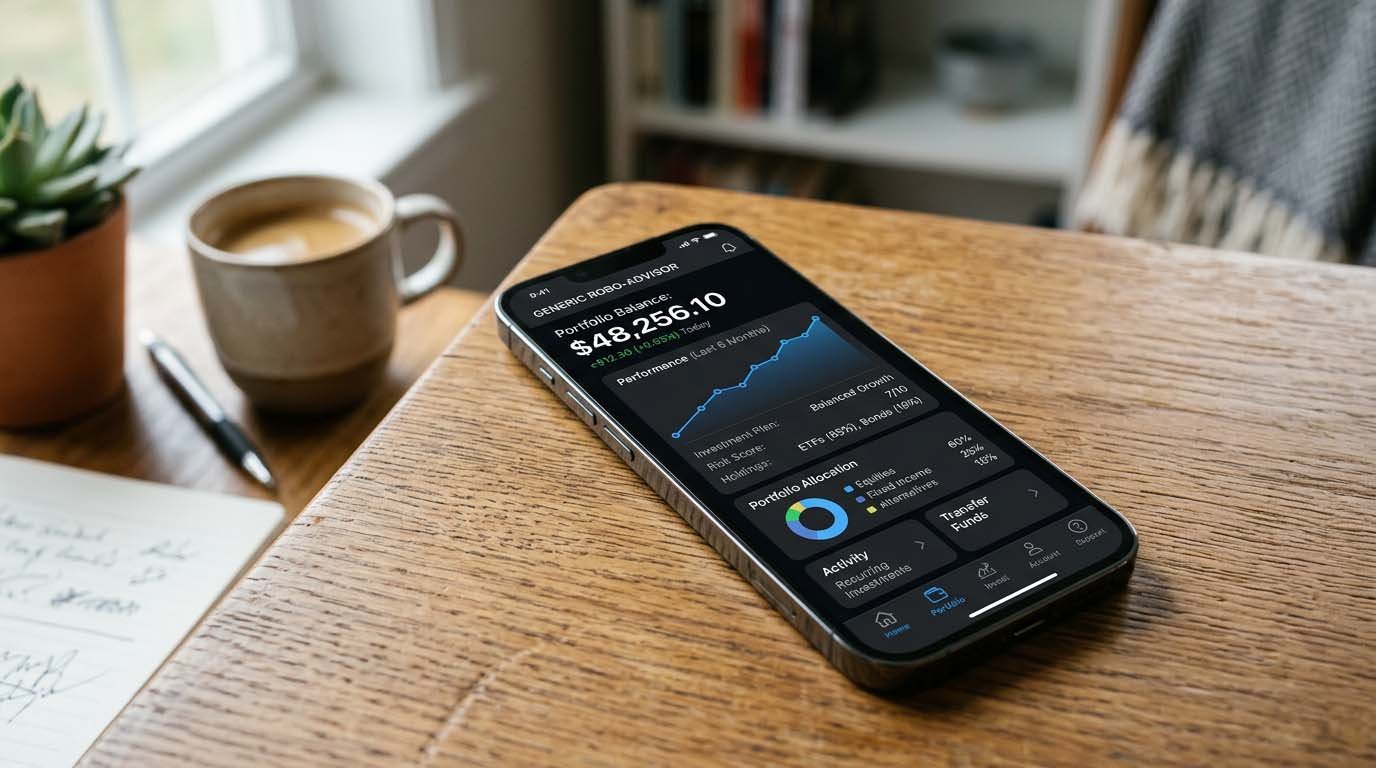
Target-date funds and many robo-advisors handle rebalancing automatically. They monitor your allocation and adjust it without requiring any action from you. This removes the most common failure point in DIY rebalancing: simply forgetting to do it, or hesitating during a volatile market when rebalancing feels emotionally uncomfortable. For investors who don’t want to manage this manually, automation is often the more reliable path to actually following through on a rebalancing plan.
Set a plan and stick to it
The specific method matters less than having a plan at all and actually following it. Whether you choose calendar-based, threshold-based, or fully automated rebalancing, the goal is the same: keeping your portfolio’s actual risk level close to the one you deliberately chose. Our How to Build a Diversified Investment Portfolio guide and Investment Calculator can help you set an initial allocation and see how it might grow, before deciding on the rebalancing approach that fits your situation best.
Write your plan down before you need it. Deciding in advance how often you’ll check, and how far the drift needs to go before you act, removes the guesswork during a stressful market moment. A written plan, even a simple one, is far easier to follow than a vague intention to “rebalance eventually” once markets settle down.
What happens if you never rebalance at all
Skipping rebalancing entirely doesn’t cause an immediate problem. In fact, over a long enough bull market, an allocation that drifts toward more stocks can even boost returns, since stocks have historically outperformed bonds over long periods. The danger shows up when that drift-heavy portfolio meets a downturn. An investor who intended to hold 60% stocks, but who let the allocation drift to 85% stocks over a decade of not rebalancing, ends up taking on far more downside risk than they originally signed up for, often without realizing it until a downturn arrives.
This is the core argument for rebalancing even when it feels unnecessary during good years. It’s not really about maximizing returns in any single year. It’s about making sure the risk you’re carrying matches the risk you actually intended to take, so a market downturn doesn’t catch you more exposed than you meant to be.
Common questions about portfolio rebalancing
Most guidance suggests once or twice a year, or whenever an asset class drifts a set percentage away from its target, commonly around five percentage points. There’s no single correct schedule, but extremes in either direction, rebalancing constantly or almost never, tend to underperform a moderate approach.
It can, depending on the account type. Rebalancing inside a tax-advantaged account like a 401(k) or IRA typically triggers no tax consequences. Rebalancing inside a taxable brokerage account can trigger capital gains taxes on any appreciated positions you sell.
Yes, if you’re regularly adding new money to the portfolio. Directing new contributions toward whichever asset class has fallen behind its target achieves a similar effect over time, without triggering a taxable sale.
A few more things worth knowing
Calendar-based rebalancing happens on a fixed schedule, like once a year, regardless of how far the allocation has drifted. Threshold-based rebalancing only triggers a rebalance once an asset class drifts a set percentage away from its target, checking more often but acting only when necessary.
Yes. Target-date funds and many robo-advisors monitor the allocation and rebalance it automatically, without requiring the investor to take any action. This is one of their main practical advantages over managing a portfolio manually.
No. Market timing involves trying to predict when prices will rise or fall. Rebalancing follows a predetermined rule based on your own portfolio’s drift, not a prediction about where the market is headed next.